A Short History of Chinese Face Reading (Mian Xiang)
Where Chinese face reading came from: early critics like Xunzi, the famous manuals attributed to Ma Yi and others, and how the practice is seen today.
Chinese face reading — miàn xiàng (面相), also called xiàng shù (相术), "the art of physiognomy" — has a history of well over two thousand years. It was practised by court advisers and street-side readers, debated by philosophers, and collected in manuals that are still reprinted today.
This is a short, plain-English overview. It is a summary of widely available histories, not a scholarly account, and we point out where dates and authorship are traditional rather than certain.
Early records and an early critic
Some of the earliest discussions of face reading in China survive because someone argued against it. The philosopher Xunzi (荀子, 3rd century BCE) wrote an essay titled "Against Physiognomy" (非相, Fēi Xiàng). He mentions physiognomists of earlier times by name and then makes his case: judging people by the shape of their face is less reliable than judging them by their thinking and their conduct.
That argument is worth remembering. Even in its classical period, face reading had serious critics inside Chinese culture itself.
The great manuals
Over the following centuries, face reading was organised into systems and written down. Two titles come up again and again:
- Ma Yi Shen Xiang (麻衣神相), traditionally attributed to a Daoist known as the "Hemp-Robed" master (麻衣道者). Its attribution and dating are traditional; the versions in circulation were compiled and expanded over a long period.
- Shen Xiang Quan Bian (神相全编), a large compendium usually dated to the Ming dynasty, which gathers earlier material into one reference.
These works give the face its familiar layers: the five features (五官), the three sections (三停), the twelve palaces (十二宫), and many named points. They also connect those areas to wider Chinese ideas such as the Five Phases (五行) and the trio of Heaven, Humanity and Earth.
ChineseFace names these manuals because they are the classic references of the field. We do not quote or translate them; our own knowledge entries are paraphrased from contemporary English-language overviews and are labelled that way.
Face reading in everyday culture
Outside the manuals, face reading became part of popular culture. Phrases about "lucky" earlobes or a "broad" forehead turn up in proverbs, opera make-up conventions and the way artists drew sages and Buddhas. Long earlobes on Buddhist statues, for example, are an artistic convention with its own history, and they show how face imagery travelled across art and belief.
How it is seen today
Today, Chinese face reading is best understood as cultural heritage: a historical way of looking at the face, with its own vocabulary and diagrams. Modern psychology has not found that facial structure reveals personality, ability, health or destiny, and many countries now regulate technology that tries to judge people from their faces.
That is the approach ChineseFace takes. We describe what is visible in your photo, then explain what the tradition said about each area, clearly separated and clearly labelled. We never tell you who you are.
Keep exploring
- What is Chinese face reading? — the map in one article.
- The five features in Chinese face reading
- Our methodology — how we write and source every entry.
Author

Categories
More Posts
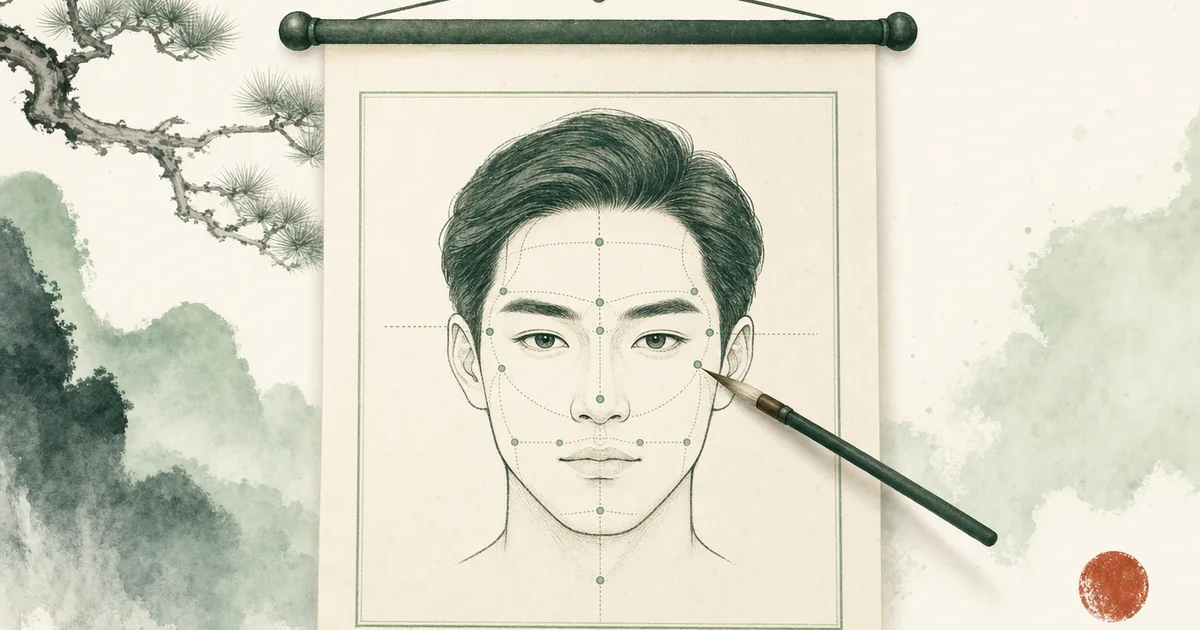
How to Read a Chinese Face Reading Chart
A step-by-step guide to the classic Chinese face reading chart: how its layers overlap, what the labels mean, and how to find each area on a real face.
How to Take the Best Photo for a Face Reading
Practical tips for a clear face reading photo: light, angle, distance, expression and what to remove, so every area of the face map is visible.

The Twelve Palaces of the Face (十二宫): A Map of Chinese Face Reading
Where each of the twelve palaces (十二宫) of Chinese face reading sits on the face, its Chinese name and pinyin, and the life theme the tradition gave it.