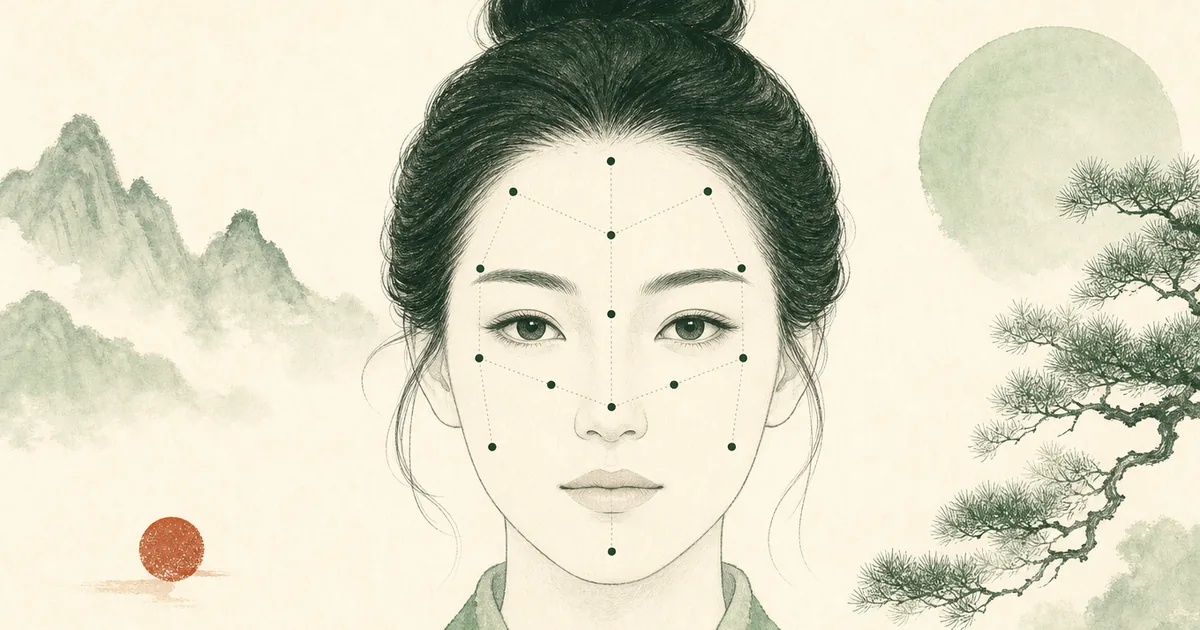
The Twelve Palaces of the Face (十二宫): A Map of Chinese Face Reading
Where each of the twelve palaces (十二宫) of Chinese face reading sits on the face, its Chinese name and pinyin, and the life theme the tradition gave it.
The twelve palaces (十二宫, shí èr gōng) are the most detailed layer of the Chinese face-reading map. The tradition placed twelve life themes — from parents to travel — onto specific areas of the face. Names and exact placements differ between manuals; below are the common modern versions, from the top of the face down.
The forehead
- Parents Palace (父母宫, fù mǔ gōng): the upper forehead on either side of center, sometimes called the sun and moon corners. Some manuals linked left and right to father and mother.
- Career Palace (官禄宫, guān lù gōng): the center of the forehead. The name refers to official rank and salary — a trace of the era when government service was the central career path.
- Travel Palace (迁移宫, qiān yí gōng): the outer upper forehead near the hairline. Travel and moving away from home mattered enough to get its own place.
- Fortune Palace (福德宫, fú dé gōng): above the outer ends of the eyebrows. The name pairs blessing (福) with virtue (德).
Around the brows and eyes
- Life Palace (命宫, mìng gōng): the space between the eyebrows, also called yìn táng (印堂). Many overviews treat it as the central palace.
- Siblings Palace (兄弟宫, xiōng dì gōng): the eyebrows themselves.
- Property Palace (田宅宫, tián zhái gōng): the upper eyelid between brow and eye — "fields and houses".
- Spouse Palace (妻妾宫, qī qiè gōng): the outer corners of the eyes, also called "fish tail" (鱼尾).
- Children Palace (子女宫, zǐ nǚ gōng): just below the eyes.
The nose and lower face
- Wellbeing Palace (疾厄宫, jí è gōng): the root of the nose between the eyes, the "mountain root" (山根). The classical name is usually translated as the palace of illness and misfortune.
- Wealth Palace (财帛宫, cái bó gōng): the tip and wings of the nose.
- Friends Palace (奴仆宫, nú pú gōng): the lower jaw on either side of the chin. The classical name refers to servants and helpers; modern overviews often say "friends" or "supporters".
You can switch to the palace layer on our face reading chart to see all twelve at once.
How to read the palaces today
The palaces are best read as a cultural index: a record of which life themes the tradition cared about, and how it chose to arrange them on the face. Notice that the list is dominated by family, home and official careers, and that some names have been softened in translation over time.
What the palaces are not is a diagnosis. A palace name like "Wealth" or "Wellbeing" says something about the tradition, not about the person whose face it is. That is why, in a ChineseFace reading, a palace card tells you where the palace sits on your face map and what it was named for — never what it "means" for you.
To see the twelve palaces placed on your own photo, start with a free preview or look at the sample report. For more on how we write these entries, see our methodology.
Author

Categories
More Posts
A Short History of Chinese Face Reading (Mian Xiang)
Where Chinese face reading came from: early critics like Xunzi, the famous manuals attributed to Ma Yi and others, and how the practice is seen today.
The Five Features in Chinese Face Reading: Eyebrows, Eyes, Nose, Mouth and Ears
A guide to the five features (五官) of Chinese face reading: the five officers, what traditional readers looked at for each feature, and what a photo can really show.
How to Read a Chinese Face Reading Chart
A step-by-step guide to the classic Chinese face reading chart: how its layers overlap, what the labels mean, and how to find each area on a real face.