Chinese face reading
The twelve palaces (十二宫) of Chinese face reading
A clear guide to the twelve palaces of Chinese face reading: where each palace sits on the face, its Chinese name, and the life theme the tradition gave it.
What the tradition looks at
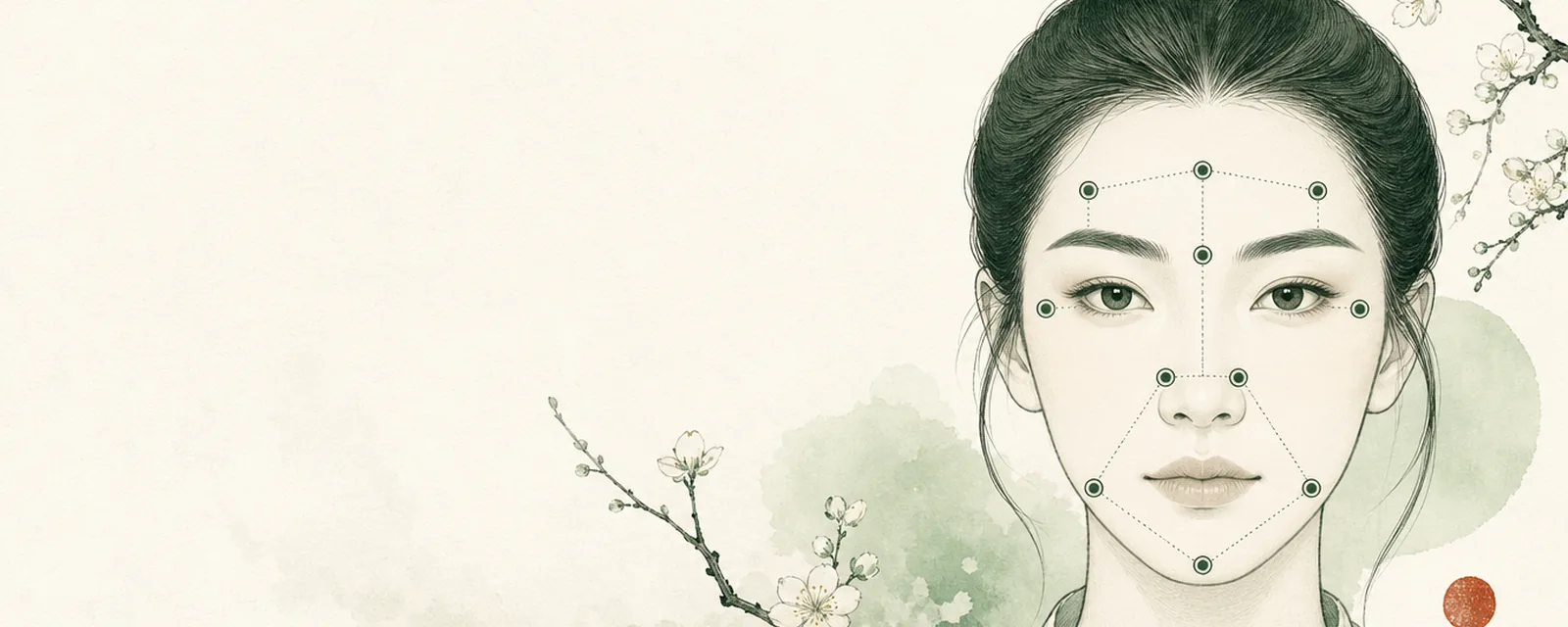
- Life Palace (命宫): the space between the eyebrows
- Wealth Palace (财帛宫): the nose, especially the tip
- Siblings Palace (兄弟宫): the eyebrows
- Property Palace (田宅宫): the upper eyelid, between brow and eye
- Children Palace (子女宫): just below the eyes
- Friends Palace (奴仆宫): the lower jaw on either side of the chin
- Spouse Palace (妻妾宫): the outer corners of the eyes, toward the temples
- Wellbeing Palace (疾厄宫): the bridge of the nose between the eyes (shān gēn)
- Travel Palace (迁移宫): the outer upper forehead near the hairline
- Career Palace (官禄宫): the center of the forehead
- Fortune Palace (福德宫): above the outer ends of the eyebrows
- Parents Palace (父母宫): the upper forehead on either side of center
The twelve palaces (十二宫 shí'èr gōng) form one of the most systematic frameworks in traditional Chinese face reading, dividing the face into twelve zones that classical texts associated with different aspects of life. Each palace occupies a specific location and the tradition held that observing its shape, clarity, and proportion offered insight into the corresponding sphere—career, family, wealth, health, and more. The palace system appears prominently in Ming-era compendia such as the Shen Xiang Quan Bian and in works associated with Yuan Gong (Liuzhuang), though the precise names and boundaries vary between texts.
Unlike the single-feature approach that examines eyes or nose in isolation, the palace map treats the face as an organized territory, each zone influencing and influenced by its neighbors. The tradition taught that balance, smooth skin, and well-proportioned features within a palace were auspicious signs, while scars, moles, lines, or sunken areas suggested challenges in that area of life.
01What the twelve palaces are in face reading
The palace system maps twelve life domains onto the face's geography. 命宫 Life Palace sits between the brows at the glabella; 财帛宫 Wealth Palace occupies the nose tip; 兄弟宫 Siblings Palace runs along the eyebrows; 田宅宫 Property Palace lies on the upper eyelids; 男女宫 Children Palace rests under the eyes at the lower lids; 奴仆宫 Friends/Servants Palace sits at the cheeks near the jaw; 妻妾宫 Spouse Palace occupies the outer eye corners; 疾厄宫 Wellbeing Palace bridges the nose at its root; 迁移宫 Travel Palace lies at the temples and hairline sides; 官禄宫 Career Palace crowns the forehead center; 福德宫 Fortune Palace sits at the eyebrow tips and outer forehead; 相貌宫 Appearance Palace (also called 父母宫 Parents Palace in some texts) occupies the upper forehead center or the sun and moon angles above the brows. Boundaries are not rigid and overlap exists.
Each palace was thought to reveal the quality and fortune of its associated domain. A clear, full, smooth palace suggested ease and success; a narrow, scarred, or dark palace hinted at obstacles. The tradition emphasized reading palaces in context—no single zone decides a reading, and the interplay of all twelve, plus the five features and three zones, formed the complete picture.
02Classical names: palaces and officers
The twelve-palace system coexists with other frameworks in the tradition, notably the five officers (五官 wǔ guān): the ears as Hearing Officer, eyebrows as Longevity Officer, eyes as Monitoring Officer, nose as审辨官 Discernment Officer, and mouth as Cashier Officer. The palaces offered finer geographic resolution, breaking down the face into more zones than the five features alone. Classical texts such as the Shen Xiang Quan Bian and works attributed to Mayi Daoist integrated both systems, sometimes overlapping palace and officer territory—the nose serves as both Discernment Officer and site of the Wealth Palace, for instance.
Names and precise locations differ slightly across sources. Some texts place the Parents Palace at the forehead's sun and moon positions (日月角 rì yuè jiǎo) above the brows, others merge it with Appearance Palace at mid-forehead. The Liuzhuang tradition and Ming compendia standardized much terminology, yet regional and lineage variations persisted. Modern learners should expect these discrepancies as natural artifacts of an oral and manuscript tradition spanning centuries.
03Traditional shapes and types within the palaces
Classical physiognomists described ideal and less-favored forms for each palace, often using metaphors from nature or architecture. The following examples capture recurring themes across the twelve zones.
- Broad and Smooth (宽平 kuān píng)
- A palace area that is wide, even, and free of lines or blemishes. The tradition associated this with abundant fortune in the corresponding domain—a broad Life Palace suggested strong vitality, a smooth Wealth Palace indicated financial ease.
- Full and Lustrous (丰润 fēng rùn)
- Flesh that appears plump and skin with a healthy sheen. Ming texts praised fullness in the Property Palace (upper lids) as a sign of family assets and in the Fortune Palace as longevity and happiness.
- Narrow and Sunken (狭陷 xiá xiàn)
- A palace zone that appears pinched, hollow, or recessed. The tradition read this as restriction or difficulty—narrow Siblings Palace suggested few brothers or strained relations, sunken Children Palace hinted at challenges with offspring.
- Marked by Lines or Scars (纹痕 wén hén)
- Visible creases, moles, or scars cutting through a palace. Classical readers viewed these as blockages or disruptions in the life area, though a single mark was rarely judged in isolation from the whole face.
- Dark or Dull (暗滞 àn zhì)
- Skin tone that looks shadowed, grayish, or lacking radiance within a palace. This was thought to signal temporary setbacks, illness, or stagnation in that sphere; the Wellbeing Palace especially was watched for color changes.
- High and Prominent (高起 gāo qǐ)
- Bone or flesh that rises noticeably—common at the Career Palace (forehead center) or cheekbones (Friends Palace). The tradition linked prominence with authority, social standing, and the ability to command respect in the palace's domain.
- Balanced with Neighbors (相应 xiāng yìng)
- A palace that harmonizes in size and tone with adjacent zones. Texts emphasized that palaces should neither overshadow nor be dwarfed by neighbors; balance across all twelve was the hallmark of a well-formed face.
04How the tradition reads the twelve palaces
Interpreters assessed each palace on clarity, proportion, and color. A palace should be proportionate to the face—not too large or too small relative to its role—and its skin should be smooth and evenly colored. The tradition taught that lines, moles, or scars acted as obstacles; a vertical line through the Life Palace, for example, was read as a sign of setbacks in vitality or life direction, while a mole in the Wealth Palace might suggest financial ups and downs. Texture mattered: oily sheen could indicate excess, dryness suggested deficiency.
Context was paramount. A single narrow palace did not doom a reading if surrounding zones were strong. The twelve palaces were read as a constellation, each influencing the others—a weak Career Palace might be supported by a robust Fortune Palace, a challenged Spouse Palace tempered by a clear Life Palace. The tradition also considered age progressions and fleeting color changes, though these subtleties required in-person observation and were less emphasized in static portraiture or written compendia.
05History and classical sources
The twelve-palace framework is most fully articulated in Ming-era texts. The Shen Xiang Quan Bian, a comprehensive compilation attributed to Chen Tuan and organized under Yuan Zhongche's name, devotes sections to each palace, detailing shapes and interpretations. The Liuzhuang Xiangfa, associated with Yuan Gong (styled Liuzhuang) and his son, similarly catalogs the palaces with practical examples. Earlier, the Mayi Xiangfa, attributed to the Song-era Mayi Daoist (though likely compiled later), mentions palace divisions but with less systematic coverage; the twelve-palace schema appears to have crystallized in the Ming period, synthesizing older territorial ideas.
Pre-Ming sources rarely enumerate exactly twelve palaces by this nomenclature. Warring States and Han writings discuss facial zones in more general terms. The formalization into twelve named palaces likely drew on correlative cosmology—twelve Earthly Branches, twelve months—and on practical mnemonic needs of teachers passing down face-reading methods. Attribution of texts to ancient sages such as Chen Tuan or Guiguzi is traditional but often symbolic; modern scholarship dates most extant manuscripts to Ming or later.
06How ChineseFace observes the palaces in a photo
ChineseFace's AI maps the twelve palace locations on an uploaded photo by identifying facial landmarks—brow ridge, glabella, nose tip, eye corners, cheekbones, temples, forehead center—and assigns each to its traditional zone. The system observes visible geometry: width, height, symmetry, and relative proportions. It does not measure skin texture in fine detail or subtle color shifts, which require controlled lighting and are subjective even in tradition. What you receive is a labeled map showing where each palace sits and, for palaces with clear shape features (a broad forehead for Career Palace, prominent cheekbones for Friends Palace), a card pairing the visible trait with what classical texts associated.
The AI cannot see moles or scars unless they create shadows or contours; it focuses on structural shape. Temporary color (a flush, a shadow from lighting) is not interpreted. The result is an introduction to the palace framework as it applies to your own face's permanent architecture, inviting you to explore the tradition's geographic logic and the cultural meanings each zone carried.
07Photo tips for capturing the twelve palaces
Because the palaces span the entire face, a clear, well-lit, front-facing photo is essential. The following tips help the AI accurately locate and measure each zone.
- Face the camera directly
- A straight-on angle ensures that forehead, temples, cheeks, and all twelve zones are visible and symmetrical. Tilting or turning the head skews palace proportions and confuses landmark detection.
- Use even, soft lighting
- Avoid harsh side light that casts shadows across the forehead (Career, Fortune palaces) or cheeks (Friends Palace). Natural daylight from a window in front of you, or a ring light, works well.
- Keep hair off the forehead and temples
- The upper palaces—Career, Fortune, Travel, Appearance/Parents—all occupy the forehead and hairline. Pin back bangs or tie hair so these zones are fully visible.
- Remove glasses
- Frames obscure the Life Palace (glabella), Siblings Palace (brows), Property Palace (upper lids), and Spouse Palace (eye corners). A photo without glasses reveals these critical zones.
- Relax your expression
- A neutral, resting face shows the natural structure of each palace. Smiling or frowning shifts cheeks, compresses the Children Palace under the eyes, and tenses the forehead, altering measured proportions.
- Ensure the entire face is in frame
- Crop that cuts off the top of the forehead loses the Career and Appearance palaces; tight framing at the sides loses the Travel and Fortune zones. Step back so the full oval from hairline to chin and ear to ear is captured.
08How the palaces relate to each other and the face map
The twelve palaces do not exist in isolation; classical texts emphasize their interplay. Vertical relationships matter—the Career Palace (forehead center) sits above the Life Palace (glabella), which sits above the Wellbeing Palace (nose root) and Wealth Palace (nose tip), forming a central axis. The tradition taught that strength in the upper zone (Career, Fortune) could support weaknesses below, and vice versa. Horizontal symmetry also counted: the paired Siblings Palaces (left and right brows), Fortune Palaces (brow tips), and Travel Palaces (temples) should balance; asymmetry suggested imbalance in those spheres.
The palace map integrates with the five officers and three zones (upper, middle, lower face). The upper zone houses Career, Fortune, Appearance, and Travel palaces and was associated with early and intellectual life; the middle zone includes Life, Siblings, Wellbeing, Property, Children, and Spouse palaces, linked to middle years and relationships; the lower zone holds Wealth and Friends palaces, connected to material and social later life. Reading the face meant synthesizing all frameworks—palaces, officers, zones, and the flow of qi across features—into a holistic cultural portrait, not a checklist of isolated verdicts.
Related guides
Frequently asked questions
Are the twelve palace locations the same in every classical text?
No. While most Ming-era sources agree on major palaces like Life (glabella) and Wealth (nose), some texts vary the placement or name of others—particularly Appearance versus Parents Palace at the forehead. Regional lineages and individual masters introduced variations. The core framework is consistent, but expect minor differences when consulting multiple sources.
Can a photo really capture what the tradition looked for in the palaces?
A photo captures structure—width, height, proportions—which the tradition emphasized. It cannot easily show fleeting skin color, fine wrinkles, or the dynamic quality classical readers observed in person. ChineseFace maps the visible geometry and pairs it with traditional associations; think of it as a static introduction to the palace framework, not a substitute for the full in-person art.
Does one weak palace mean bad fortune in that area of life?
The tradition never reduced a reading to a single palace. Interpreters looked at the whole face, the balance of all twelve zones, and the support or challenge from neighboring features. A narrow or marked palace was noted but weighed against strengths elsewhere. The cultural teaching was holistic, not deterministic.
Why are there twelve palaces specifically?
Twelve likely resonates with Chinese cosmological sets—twelve Earthly Branches, twelve double-hours, twelve months—offering a mnemonic and symbolic structure. The number also provides granular coverage of the face without becoming unwieldy. The systematization into exactly twelve named palaces appears to have solidified in the Ming period, synthesizing older zone concepts.
How does ChineseFace decide which palace shapes to highlight?
The AI identifies visible geometric features—forehead breadth, cheekbone prominence, glabellar width—and matches them to palace locations and traditional shape categories in its training data. Only well-established visible traits are labeled. If a palace shows no distinctive measurable feature in your photo, it may not generate a card; the map itself shows all twelve locations regardless.