What Is Chinese Face Reading? A Clear Guide to Mian Xiang
What Chinese face reading (面相, mian xiang) is, how the tradition maps the face in five features, three sections and twelve palaces, and how to approach it today.
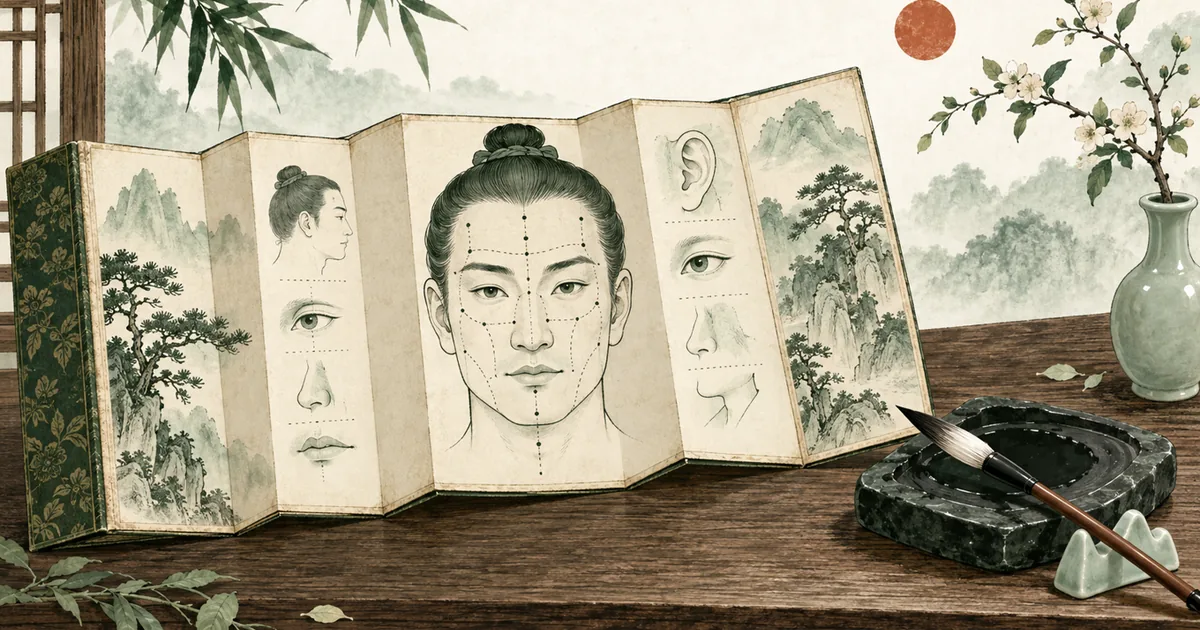
Chinese face reading, or miàn xiàng (面相), is a long-standing Chinese tradition that treats the human face as a map. Practitioners named areas of the face, connected them to ideas from Chinese cosmology, and wrote manuals that were copied and reprinted for centuries.
This guide explains how that map is built, what the tradition actually claims, and how to explore it today without treating it as a verdict on who you are.
A face drawn as a map
The tradition does not look at a face all at once. It organizes the same face in several overlapping layers:
- The five features (五官, wǔ guān): eyebrows, eyes, nose, mouth and ears. Each was given an "officer" title describing the role the tradition imagined for it — the eyes, for example, are the "Inspecting Officer".
- The three sections (三停, sān tíng): the face split horizontally from hairline to brow, brow to the base of the nose, and nose to chin. These were linked to Heaven, Humanity and Earth.
- The twelve palaces (十二宫, shí èr gōng): twelve named areas, each tied to a life theme such as family, home, career or travel.
Readers in the tradition combined these layers, paying more attention to balance and proportion than to any single feature. You can see all three on our face reading chart.
Where the tradition comes from
Face reading belongs to a wider family of Chinese divination and cosmological thinking that also includes ideas like yin and yang and the Five Elements. Classical manuals such as the Ma Yi Shen Xiang (麻衣神相) and the Shen Xiang Quan Bian (神相全编) are often cited as the reference texts of the field. Their wording and placements differ, which is why modern English overviews do not always agree on names or translations.
We do not quote these texts on ChineseFace. Our entries are paraphrased from contemporary English-language overviews and say so — see our methodology.
What face reading is — and is not
It is a cultural tradition: a way people organized ideas about life, family and fortune onto the face. It is worth knowing as history, language and art. Names like "phoenix eyes" or the "mountain root" (山根) at the bridge of the nose are part of that vocabulary.
It is not science. There is no evidence that the shape of your nose or the gap between your eyebrows reveals your character, your health or your future. Historically, reading people's faces to judge them has also been used to justify prejudice. That is why ChineseFace keeps two things strictly apart:
- What is visible — a plain description of shape, position and proportion in your photo.
- What the tradition says — cultural context about that area, written about the tradition, never about you.
How to explore it today
A good way to approach mian xiang is with curiosity rather than belief:
- Learn the map first: the five features, the three sections and the twelve palaces.
- Notice what the tradition chose to map — family, home, official careers, travel. It tells you a lot about the priorities of the societies that wrote it.
- Treat any "meaning" as a story the tradition tells, not a fact about a person.
If you would like to see the map on your own face, ChineseFace gives you a free preview from one photo, or you can look at a complete sample report first.
Author

Categories
More Posts
A Short History of Chinese Face Reading (Mian Xiang)
Where Chinese face reading came from: early critics like Xunzi, the famous manuals attributed to Ma Yi and others, and how the practice is seen today.
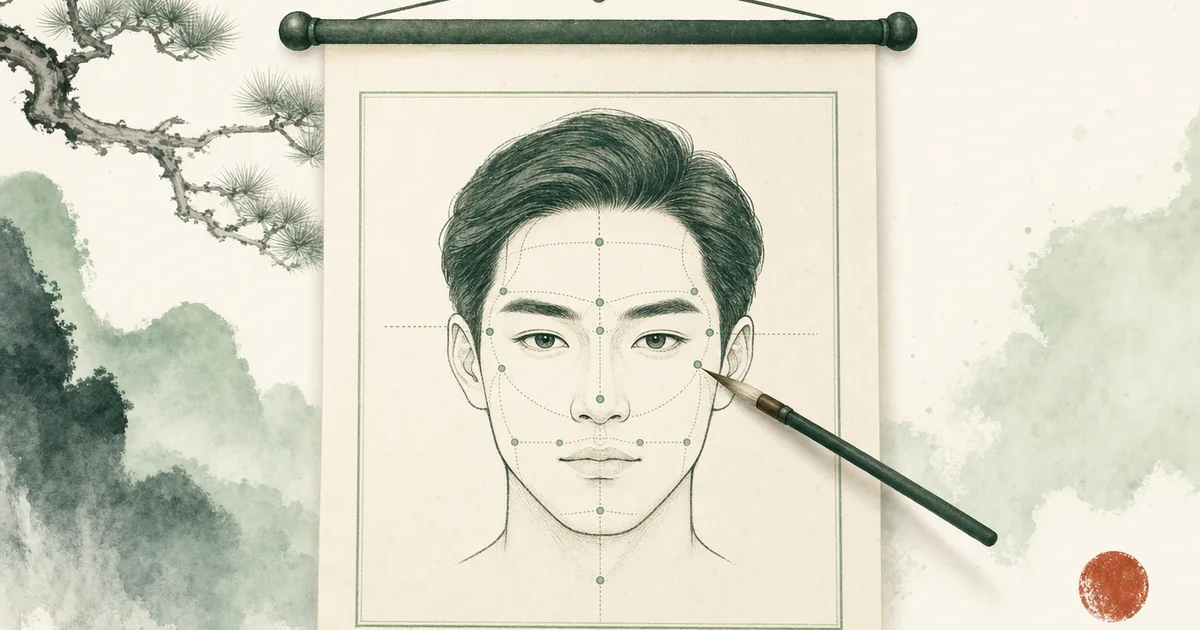
How to Read a Chinese Face Reading Chart
A step-by-step guide to the classic Chinese face reading chart: how its layers overlap, what the labels mean, and how to find each area on a real face.
20 Chinese Face Reading Terms, with Pinyin and Characters
Learn the core vocabulary of Chinese face reading (面相): 20 essential terms with characters, pinyin and plain-English explanations.