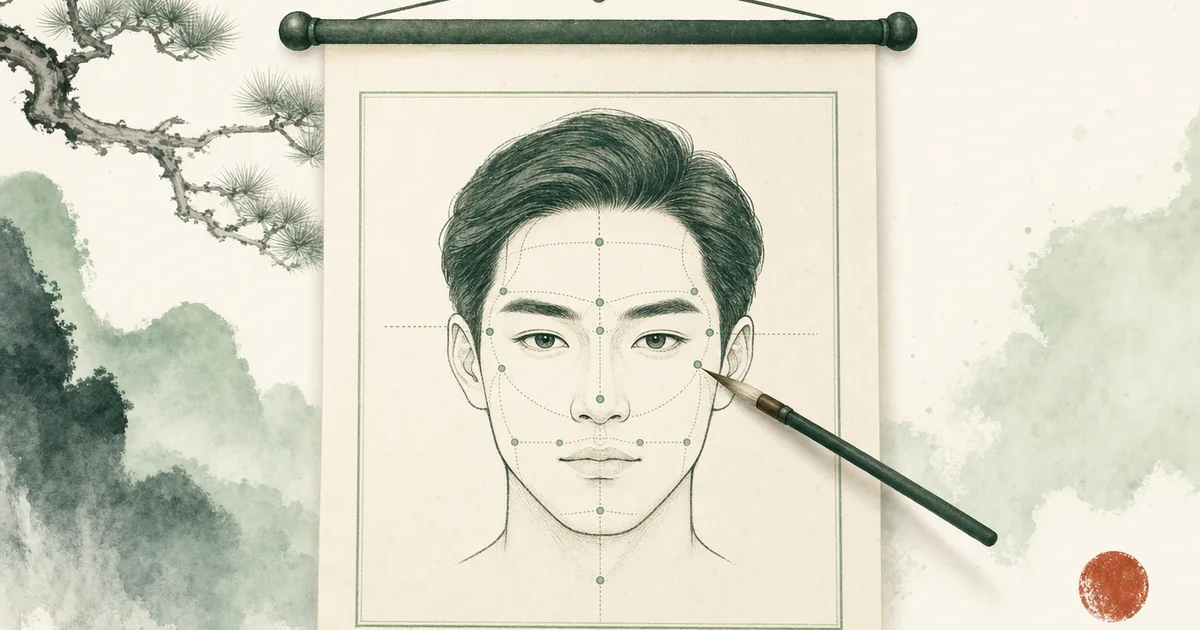
How to Read a Chinese Face Reading Chart
A step-by-step guide to the classic Chinese face reading chart: how its layers overlap, what the labels mean, and how to find each area on a real face.
If you have ever seen a traditional Chinese face reading chart, you know it can look overwhelming: dozens of labels, lines and characters packed onto one small face. The good news is that almost every chart is built from the same few layers. Once you can separate them, the chart becomes easy to follow.
Step 1: Find the three horizontal lines
Start with the biggest structure. Most charts mark, or at least imply, two horizontal lines: one at the brow line and one at the base of the nose. Together with the hairline and chin, they create the three sections (三停, sān tíng).
Read them from top to bottom: upper (上停), middle (中停), lower (下停). Everything else on the chart sits inside one of these bands. Our guide to the three sections explains them in detail.
Step 2: Locate the five features
Next, find the five features (五官, wǔ guān): eyebrows (眉), eyes (眼), nose (鼻), mouth (口) and ears (耳). Charts often label them with their "officer" titles — for example the eyes are the Inspecting Officer (监察官). If you see a title ending in 官, it almost always refers to one of these five.
Step 3: Read the palace labels
The labels ending in 宫 (gōng, "palace") belong to the twelve palaces (十二宫). These are the most crowded part of a chart, so take them one region at a time:
- Forehead: Career (官禄宫), Parents (父母宫), Travel (迁移宫), Fortune (福德宫).
- Between and around the eyes: Life (命宫) between the brows, Siblings (兄弟宫) on the brows, Property (田宅宫) on the upper eyelid, Children (子女宫) below the eyes, Spouse (妻妾宫) at the outer corners.
- Nose: Wellbeing (疾厄宫) on the bridge, Wealth (财帛宫) at the tip.
- Jaw: Friends (奴仆宫) on either side of the chin.
The names describe the life themes the tradition attached to each area. They are part of the history of the chart, not a reading of the person drawn on it. See the twelve palaces guide for each one.
Step 4: Notice the extra points
Detailed charts add many smaller named points, such as yìn táng (印堂) between the eyebrows and shān gēn (山根), the "mountain root" at the top of the nose. Our glossary lists the most common terms with characters and pinyin.
Step 5: Move from drawing to photo
Charts use an idealised face. Real faces — and especially photos — differ: angle, lens distance and hairstyle all move the landmarks. When you place the chart on a photo, treat every position as approximate. That is exactly why ChineseFace shows a "partly visible" note when part of the face is covered.
Try it
Open our interactive face reading chart to switch between layers, or upload a photo on the home page to see the same layers drawn on your own face.
More Posts
What Is Chinese Face Reading? A Clear Guide to Mian Xiang
What Chinese face reading (面相, mian xiang) is, how the tradition maps the face in five features, three sections and twelve palaces, and how to approach it today.


A Short History of Chinese Face Reading (Mian Xiang)
Where Chinese face reading came from: early critics like Xunzi, the famous manuals attributed to Ma Yi and others, and how the practice is seen today.

The Three Sections of the Face (San Ting) Explained
How Chinese face reading divides the face into three sections (三停, san ting), how each one is measured on a photo, and what the tradition linked them to.