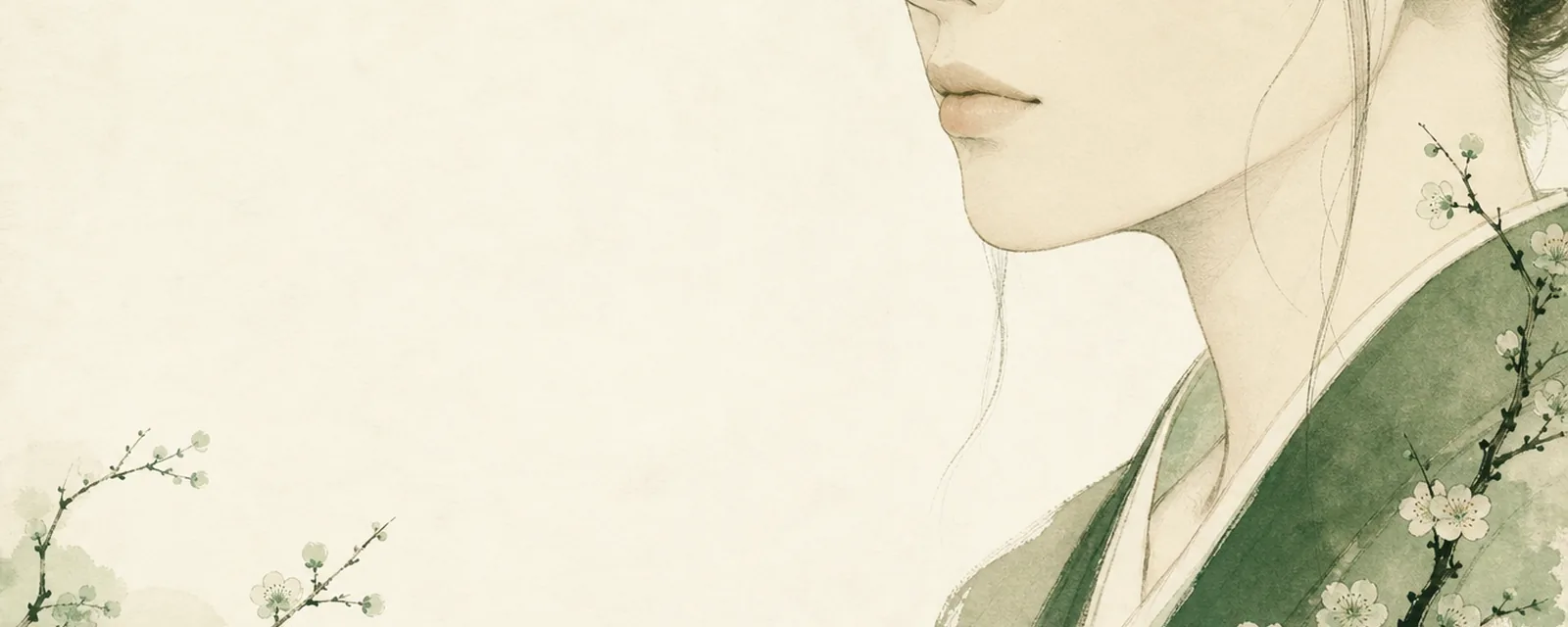
Chinese face reading
The mouth in Chinese face reading
The mouth (口) in Chinese face reading, the Speaking Officer: width, lips and corners as the tradition describes them, and why a neutral face matters.
What the tradition looks at
- Width compared with the eyes
- Fullness of the upper and lower lips
- Corners at rest
The mouth (口 kǒu) is one of the most expressive and carefully observed regions in Chinese face reading. Positioned at the centre of the lower face, it serves as the 出纳官 Chūnà Guān (Speaking and Receiving Officer), reflecting the tradition's understanding of how one communicates, receives nourishment, and engages with the world. Its shape, proportion, and relationship to surrounding features carried detailed meanings in classical texts.
The mouth connects intimately with the philtrum (人中 rénzhōng) above and the chin dimple (承浆 chéngjiāng) below, forming a vertical axis in the lower section (下停 xiàtíng) of the face. Many texts also associate the mouth with 水星 Shuǐxīng (the Water star) in the system of five stars or six luminaries (五星 wǔxīng, 六曜 liùyào), linking it to fluidity, adaptability, and sustenance. ChineseFace maps visible contours, lip proportion, and width to help users explore what the tradition said about these features.
01The Mouth Region in Mian Xiang
In face reading, the mouth is understood as the gateway for both speech and sustenance, and classical practitioners paid close attention to its size, shape, symmetry, and the quality of the lips. The tradition viewed the mouth as revealing how one interacts verbally and socially, and how one receives resources and support. A well-formed mouth—balanced, clear in outline, and harmonious with the face—was associated with effective communication and smooth social exchange.
The mouth sits at the heart of the lower third of the face, anchoring the region concerned with later life, material circumstances, and fulfillment. Its vertical position between the philtrum and the承浆 point, and its horizontal relationship to the cheeks and jaw, made it a key reference in assessing overall facial balance. The tradition noted both static form and, where observable, the way the mouth moved or rested.
02Classical Names, Officers and Palaces
The mouth is formally called the 出纳官 Chūnà Guān, the Speaking and Receiving Officer, a title emphasizing its dual role: speech flowing outward and nourishment coming inward. Some texts refer to it as 水星 Shuǐxīng (Water star), one of the 五星 wǔxīng (five stars—metal, wood, water, fire, earth) or 六曜 liùyào (six luminaries) that correspond to facial features. Water's qualities of flow, depth, and adaptability informed the tradition's associations.
The mouth does not occupy a numbered palace (宫 gōng) by itself but is closely tied to the 承浆 chéngjiāng point (age 60 in some maps) and the broader 地阁 dìgé (earth pavilion) of the lower face. The 人中 rénzhōng (philtrum) immediately above forms a crucial companion, and together they create a vertical channel thought to reflect continuity and connection in one's circumstances.
03Traditional Shapes and Types
Classical texts describe many mouth shapes, each with its own traditional associations. The names often derive from visual resemblance or poetic metaphor, and the same physical mouth might be described differently across texts. Below are several well-known types recorded in works like the Mayi Xiangfa and Shen Xiang Quan Bian.
- Four-Character Mouth (四字口 sìzì kǒu)
- A wide, rectangular mouth resembling the character 四, with clear horizontal lines and firm corners. The tradition associated this shape with strong communication skills, directness, and stability in later years.
- Cherry Mouth (樱桃口 yīngtáo kǒu)
- A small, rounded mouth, likened to a cherry, with full lips and gentle contours. Traditionally linked to refinement, quiet speech, and a measured approach to social interaction.
- Bow Mouth (弓口 gōng kǒu)
- Upper lip curves like a bow, with a pronounced Cupid's bow and defined peaks. The tradition saw this as indicating expressive speech and a certain grace in manner.
- Square Mouth (方口 fāng kǒu)
- Lips form a broad, stable rectangle with little curvature. Associated with straightforwardness, practical communication, and an even temperament in exchanges.
- Carp Mouth (鲤鱼口 lǐyú kǒu)
- Downturned corners and slightly protruding lips, resembling a carp's mouth. Traditionally interpreted with caution, as some texts linked it to verbal challenges or a tendency toward complaint; others simply noted the distinctive shape.
- Covered-Boat Mouth (覆舟口 fùzhōu kǒu)
- Upper lip long and slightly overhanging the lower, like an overturned boat. Classical descriptions varied, but the shape was noteworthy for its asymmetry and the tradition often discussed balance and speech patterns.
- Willow-Leaf Mouth (柳叶口 liǔyè kǒu)
- Narrow, elongated, with a gentle taper, resembling a willow leaf. Traditionally associated with careful, considered speech and a reflective communication style.
04How the Tradition Reads the Mouth
Proportion is central: the mouth's width relative to the face, the balance between upper and lower lips, and symmetry of the corners all mattered. A mouth too small or too large for the face, or lips markedly uneven, drew comment. The tradition favored clear definition—a mouth neither too slack nor too tight—and a natural alignment with the vertical midline. Harmony with the philtrum and chin reinforced positive readings.
Texture and color were also noted in classical practice. Smooth, well-moistened lips with healthy tone were preferred; dryness, cracks, or pallor were thought to reflect temporary states rather than fixed features, but still observed. The tradition also considered the visibility of teeth when the mouth was at rest, the depth of the corners, and how the mouth integrated into the lower face's overall structure. These subtleties required direct observation and were less about isolated features than relationships.
05History and Classical Sources
The Mayi Xiangfa (麻衣相法), a Song-era tradition attributed to the semi-legendary Mayi Daoist, discusses the mouth as one of the five sense organs and describes several shapes, linking them to communication and resource flow. The Liuzhuang Xiangfa (柳庄相法), associated with the Ming physiognomist Yuan Gong (袁珙, styled Liuzhuang) and his son Yuan Zhongche, offers detailed classifications of mouth types, emphasizing proportion and balance with the rest of the lower face.
The Shen Xiang Quan Bian (神相全编), a large Ming compendium traditionally connected to Chen Tuan and compiled under Yuan Zhongche's name, provides extensive descriptions of mouth shapes and their traditional meanings, often illustrated with poetic names. These texts built on earlier ideas about the face found in Warring States and Han writings, though systematic mouth typologies became more elaborate in later centuries. Attribution and exact wording vary, and many mouth-type names appear across multiple sources with slight differences.
06How ChineseFace Observes the Mouth
ChineseFace detects the mouth's outline, measures its width relative to facial landmarks, and assesses the proportion of upper and lower lips. The system identifies visible contours, symmetry of the corners, and the overall shape category (wide, narrow, full, thin, angular, rounded). These are structural observations: what the camera captures in a still, front-facing photo with a neutral expression.
The app does not evaluate texture, moisture, fine lines, or subtle color variations, which require close examination and lighting beyond a standard upload. It cannot assess how the mouth moves, speaks, or changes with emotion.
07Photo Tips for the Mouth Region
A clear, well-lit photo with a relaxed, neutral expression allows the most accurate mapping of the mouth. Follow these suggestions for best results.
- Neutral expression, lips closed gently
- Avoid smiling, pursing, or pressing lips together, as these alter the natural shape and proportion the tradition describes.
- Front-facing, level camera
- Hold the camera at eye level, looking straight ahead, so the mouth is not foreshortened or angled, which distorts width and symmetry.
- Even, diffuse lighting
- Soft light from in front (not harsh overhead or side light) reveals the mouth's contours clearly without heavy shadows on the lips or chin.
- No lipstick or gloss if possible
- Bare lips show natural color and texture; heavy makeup can obscure the true outline and confuse edge detection.
- Clean face, no food or drink residue
- Even small marks near the mouth can interfere with contour recognition; a quick rinse ensures a clean read.
- Relax jaw and face
- Tension can pull the mouth into an unnatural position; take a breath, release your shoulders, and let your face settle before the photo.
08Relation to Neighboring Regions
The mouth does not stand alone. Directly above, the philtrum (人中 rénzhōng) channels the midline down from the nose, and its length, depth, and clarity are read in concert with the mouth's width and position. Below, the承浆 chéngjiāng point and the chin (地阁 dìgé) complete the lower vertical axis; a strong chin and well-defined承浆 were thought to balance and support a well-formed mouth. Laterally, the cheeks (颊 jiá) and the法令纹 fǎlìngwén (nasolabial folds) frame the mouth and influence how it appears within the face.
In the tradition, harmony among these neighbors mattered more than any single feature. A beautifully shaped mouth with a weak or indistinct philtrum, or a mouth misaligned with the nose and chin, would be noted as lacking full balance. The classical texts remind us that mian xiang is about relationships—how one feature supports, complements, or contrasts with another, and how together they compose the living map of the face.
Related guides
Frequently asked questions
Why is the mouth called the Speaking and Receiving Officer?
The title 出纳官 Chūnà Guān reflects the mouth's dual role: speech flows outward (出 chū, to issue), and nourishment comes inward (纳 nà, to receive). This classical name emphasizes function and exchange, central themes in the tradition's understanding of the mouth.
Can ChineseFace tell if my lips are dry or healthy?
No. ChineseFace maps visible shape, proportion, and contour from a still photo. It does not assess texture, moisture, color tone, or temporary states like dryness. For those details, direct observation in good light is needed.
Do all classical texts agree on mouth types and meanings?
No. Names, classifications, and associations vary between texts like the Mayi Xiangfa, Liuzhuang Xiangfa, and Shen Xiang Quan Bian. Some shapes have multiple names, and the same name may describe slightly different forms. The tradition is rich and diverse, not a single fixed system.
Should I smile or keep a neutral expression for the photo?
Keep a neutral, relaxed expression with lips gently closed. Smiling changes the mouth's shape, width, and corners, and the classical descriptions refer to the resting form. A neutral face allows the most accurate mapping of your natural structure.