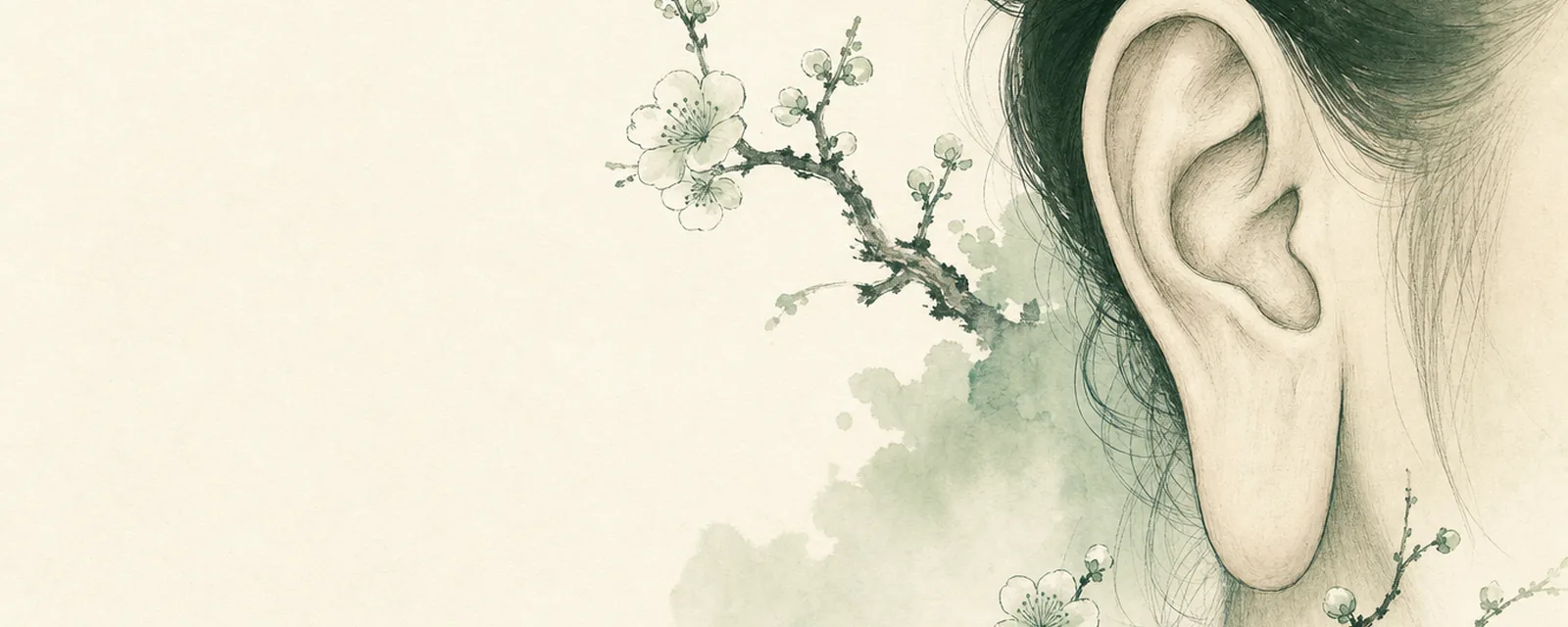
Chinese face reading
Ears in Chinese face reading
The ears (耳) in Chinese face reading, the Listening Officer: height, earlobes and angle, and the history of long earlobes in Chinese art.
What the tradition looks at
- Height of the ear compared with the brow and nose
- Size of the earlobe
- How close the ear lies to the head
The ears, 耳 ěr, occupy a unique place in Chinese face reading because they frame the face and are believed to reveal foundations set early in life. The tradition holds that the ears express one's constitutional vitality, longevity prospects, and the quality of fortune in youth. Classical texts often examine the ears first, before the features in the center of the face, treating them as indicators of underlying strength and the capacity to receive wisdom.
Known as the 采听官 Cǎi Tīng Guān, the Listening Officer, the ears are said to govern one's ability to gather information and heed counsel. In the五星 wǔ xīng, Five Stars, framework, the left ear corresponds to 金星 Jīn Xīng, the Metal Star, and the right to 木星 Mù Xīng, the Wood Star, linking them to elemental balance. Well-formed ears with prominent earlobes, called 垂珠 chuí zhū or hanging pearls, appear in Buddhist iconography as markers of wisdom and compassion, and the tradition associates such features with material comfort and a generous nature.
01The Ears in Mian Xiang
In the face-reading map, the ears are read as the foundation of the face, tied to the years of childhood and adolescence. The left ear traditionally corresponds to ages one through seven, the right to ages eight through fourteen, though systems vary. Because the ears complete their major growth early in life, the tradition treats them as records of prenatal vitality and the circumstances of one's upbringing. They are also thought to reflect kidney essence and longevity, drawing on correspondences with internal-organ theory that appear in later commentaries.
02Classical Names, Officers and Palaces
The ears are the 采听官 Cǎi Tīng Guān, the Listening Officer, one of the five or six officers of the face depending on the scheme. This title emphasizes receptivity: the capacity to hear advice, discern truth, and absorb learning. In palace systems the ears themselves may be divided into upper, middle, and lower zones—天轮 tiān lún (heaven wheel), 人轮 rén lún (human wheel), and 地轮 dì lún (earth wheel)—or the entire ear treated as the 耳门 ěr mén, Ear Gate, a portal for fortune. The 垂珠 chuí zhū, the lobe, receives special attention as a sign of blessing and longevity.
03Traditional Shapes and Types
Classical texts describe many ear forms, each associated with particular qualities. The tradition valued certain proportions—length, thickness, position relative to the brows and nose tip—and the relationship between the outer helix, 轮 lún, and the inner fold, 廓 kuò. Ears set high, level with or above the brows, were considered auspicious, while low-set ears were read less favorably. Texts also note color and luster, though these are difficult to assess from a single photograph.
- Hanging-Bead Ear (垂珠耳 chuí zhū ěr)
- Ears with large, fleshy, pendant lobes. The tradition associated this form with wealth, longevity, and a generous disposition, and it appears prominently in images of the Buddha and bodhisattvas.
- Stick-Close Ear (贴脑耳 tiē nǎo ěr)
- Ears that lie flat against the head when viewed from the front. Classical readers linked this shape with obedience, steady fortune, and freedom from early hardship.
- Opposite Ear (对面耳 duì miàn ěr)
- Ears that stand away from the head, visible from a frontal view. The tradition sometimes read this as independence or stubbornness, and outcomes depended on other features and overall balance.
- Chess-Piece Ear (棋子耳 qí zi ěr)
- Round, thick ears resembling a Go stone. Texts describe this form as indicating stable fortune and a calm temperament, especially when the lobe is full.
- Thin Ear (薄耳 báo ěr)
- Ears with little flesh, appearing delicate or papery. The tradition associated thinness with fragility in youth or a restless nature, though context and other features modified the reading.
- High Ear (高耳 gāo ěr)
- Ears whose upper rim sits level with or above the eyebrows. Classical texts considered high placement a mark of intelligence and early good fortune.
- Low Ear (低耳 dī ěr)
- Ears positioned below the tip of the nose. Low-set ears were read as indicating challenges in youth, though a well-formed low ear could still be seen as auspicious if other features were strong.
- Tiger Ear (虎耳 hǔ ěr)
- Large, prominent ears with a strong helix. The tradition linked this form with courage and authority, drawing on the symbolic power of the tiger.
04How the Tradition Reads Ears
Proportion and balance govern ear interpretation. Height is measured against the brows and nose tip: ideally the top of the ear aligns with the brow, the lobe with the nose tip. Thickness matters—fleshy ears are preferred to thin—and symmetry between left and right is noted. The relationship between the outer helix and inner antihelix should be clear and harmonious; a weak or reversed廓 kuò was read as inauspicious. Color is mentioned in texts (a bright, lustrous tone seen as healthy; dullness or darkness as problematic), but lighting and skin tone make color assessment unreliable in photographs. Texture, such as smoothness versus roughness, also appears in classical commentary but is similarly hard to judge from a static image.
05History and Classical Sources
Ears receive detailed treatment in the major physiognomy traditions. The 麻衣相法 Mayi Xiangfa, attributed to the Mayi Daoist of the Song, discusses ear forms and their relation to constitutional strength. The 柳庄相法 Liuzhuang Xiangfa, associated with the Ming-era Yuan Gong and his son Yuan Zhongche, categorizes ear shapes and ties them to fortune in youth. The 神相全编 Shen Xiang Quan Bian, a comprehensive Ming compendium, presents systematic schemes for ear zones, types, and their meanings, drawing on earlier material. All three sources emphasize the ears as foundational, to be examined early in a reading. The link between ear form and longevity likely reflects broader correlations in traditional medicine, though the texts themselves present it as observational wisdom.
06How ChineseFace Observes Ears
ChineseFace maps visible spatial features: ear height relative to the brows and nose tip, the prominence of the lobe, the degree to which ears stand away from or lie close to the head, and the general proportion of upper to lower ear. The system does not assess color, luster, or fine texture, which depend on lighting, camera settings, and skin tone. It notes left-right symmetry where visible. Because a frontal photograph shows limited detail of ear contours, especially the inner folds, the reading focuses on overall size, position, and lobe shape. Angled or profile photos are not used, so some classical distinctions cannot be detected.
07Photo Tips for Clear Ear Reading
A well-lit, frontal photo with hair pulled back allows the system to measure ear position and size accurately. Even lighting from the front minimizes shadows that obscure the ears or alter their apparent shape.
- Pull hair behind ears
- Hair covering the ears prevents the system from locating landmarks and measuring height or lobe size.
- Face directly forward
- A straight-on angle ensures both ears are equally visible and height can be compared with brows and nose tip.
- Remove earrings and accessories
- Large earrings or ear cuffs can obscure the lobe or helix, interfering with shape detection.
- Use even, neutral lighting
- Side lighting or harsh shadows can make one ear appear darker or smaller, skewing symmetry assessment.
- Neutral expression, head level
- Tilting the head up or down shifts the apparent position of the ears relative to the brows and nose.
- Avoid filters and heavy editing
- Smoothing or reshaping filters can alter ear contours and lobe definition, reducing detection accuracy.
08Ears in the Whole-Face Map
The ears provide a vertical reference for the rest of the face. Their height anchors the reading of the brows, eyes, and nose tip, and the tradition considers the ears in relation to these neighbors when assessing balance and harmony. A face with strong, well-positioned ears but weak central features might be read as having a solid foundation without full development; conversely, prominent central features with weak ears suggest challenges rooted in early life. The left and right ears are also read for symmetry with each other, as imbalance was thought to reflect uneven fortune or health. In the 五星 wǔ xīng system, the ears as Metal and Wood stars must harmonize with the other elemental stars—forehead (Fire), nose (Earth), and mouth or chin (Water)—for an auspicious overall reading. The tradition reminds readers that no single feature determines a fate; the ears are one chapter in the story the face is said to tell.
Related guides
Frequently asked questions
Why does the tradition connect ears with early life and longevity?
Because ears largely complete their growth in childhood, classical texts treated them as markers of conditions present from birth—constitution, family circumstances, and early fortune. The link to longevity likely draws on correspondences with kidney essence in traditional medicine, though the texts present it as observational.
Can ChineseFace measure my earlobes and ear position accurately?
ChineseFace detects ear height relative to brows and nose tip, lobe prominence, and whether ears lie close or stand away, provided hair is pulled back and lighting is even. It does not assess color, fine texture, or inner contours that require close inspection or profile views.
What if my ears are different shapes or sizes?
Asymmetry is common and normal. The tradition noted left-right differences and sometimes read them as reflecting imbalance, but no predictive or diagnostic meaning should be taken from this. ChineseFace simply maps what is visible; interpretation belongs to cultural history.
Why are large earlobes so emphasized in Buddhist art and the tradition?
The垂珠 chuí zhū, or hanging-bead lobe, appears in images of the Buddha and bodhisattvas as a symbol of wisdom, compassion, and spiritual merit. In face reading it was associated with material comfort and longevity, reflecting the cultural value placed on fullness and fleshiness as signs of abundance and health.