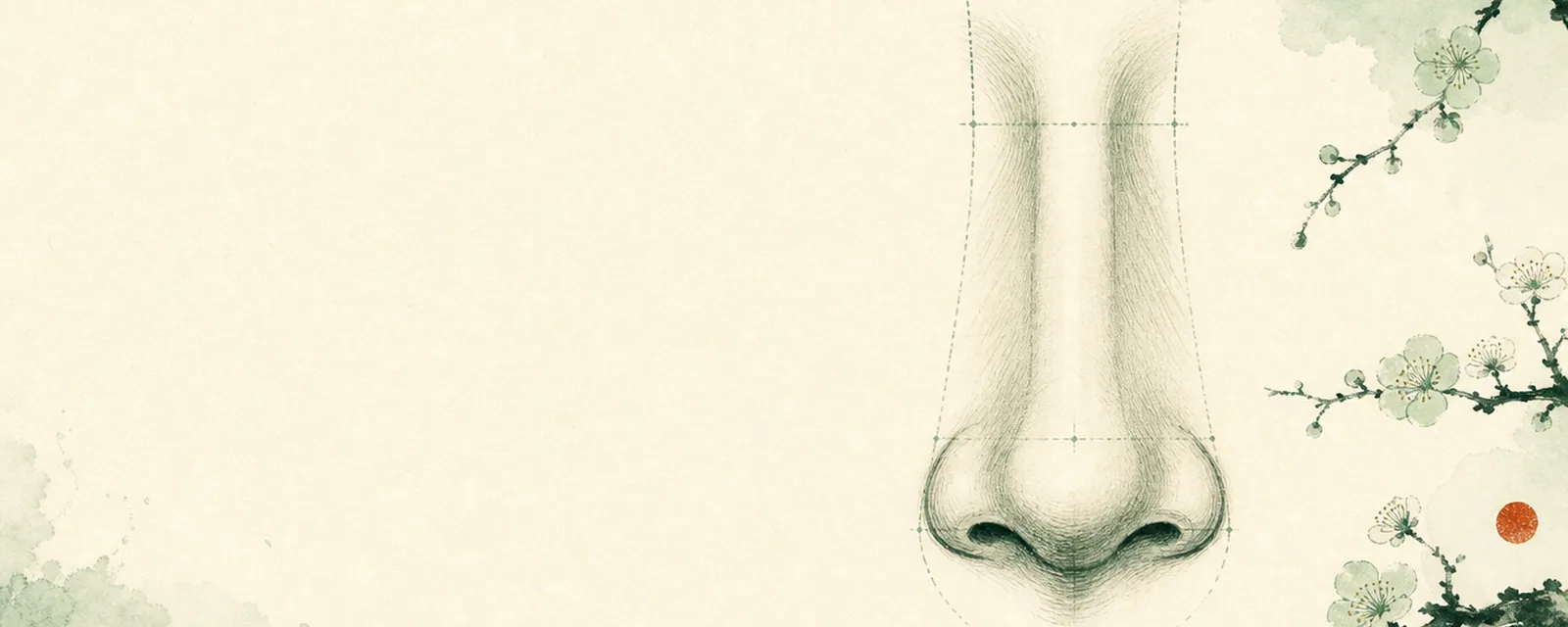
Chinese face reading
The nose in Chinese face reading
The nose (鼻) in Chinese face reading: the Judging Officer, the mountain root and the Wealth Palace, with what the tradition looks at and its limits.
What the tradition looks at
- Line of the bridge
- Width and roundness of the tip
- Nostril wings
- How the nose sits between the cheekbones
The nose (鼻 bí) occupies the central position of the face and serves as the primary vertical landmark in Chinese face reading. Positioned in the middle section (中停 zhōng tíng), it extends from the mountain root (山根 shān gēn) between the eyebrows down to the tip (准头 zhǔn tóu) and wings (兰台 lán tái and 廷尉 tíng wèi), dividing the face into left and right halves and anchoring the entire facial structure.
The tradition refers to the nose as the central peak (中岳 zhōng yuè) among the five peaks (五岳 wǔ yuè) of the face, reflecting its importance in classical physiognomy. It encompasses multiple palaces and serves as the Judging Officer (审辨官 shěn biàn guān), one of the Five Officers, overseeing discernment and assessment. The nose connects health indicators at the mountain root with prosperity associations at the tip, making it a region rich in traditional interpretive meaning.
01The Nose Region in Mian Xiang
The nose forms the face's vertical axis and occupies prime territory in the middle section, the life stage traditionally associated with the years from approximately 41 to 50. Its prominence and central location made it a focal point in classical texts, which devoted extensive commentary to its variations in size, shape, straightness, and proportion. The nose bridges the upper face (forehead and brow) with the lower face (mouth and jaw), serving as both a physical and symbolic connector.
As one of the Five Officers, the Judging Officer role assigned to the nose reflects traditional associations with evaluation, measurement, and balance. The nose was seen as governing one's capacity to assess situations and make determinations, a metaphor drawn from its central, observing position on the face.
02Classical Names, Officers, and Palaces
The mountain root (山根 shān gēn) marks the bridge between the eyebrows and forms part of the Wellbeing Palace (疾厄宫 jí è gōng), an area the tradition linked to health and resilience. Midway down the bridge lie the year seat (年上 nián shàng) and longevity seat (寿上 shòu shàng), points associated with the mid-forties in the traditional age mapping. The nose tip (准头 zhǔn tóu) constitutes the Wealth Palace (财帛宫 cái bó gōng), an area classical texts frequently discussed in relation to material circumstances and resources.
The nostril wings carry the names Orchid Terrace (兰台 lán tái, left) and Court Guardian (廷尉 tíng wèi, right), minor palaces flanking the tip. Together these anatomical landmarks create a micro-geography that classical physiognomists read as a vertical narrative, from foundational health at the root through midlife milestones to prosperity indicators at the tip.
03Traditional Nose Shapes and Types
Classical texts categorize noses into numerous types, each shape carrying particular traditional associations. Shape descriptions focus on overall proportion, the bridge profile, tip form, and nostril size. The tradition emphasized harmony between the nose and surrounding features, with no single shape held as universally ideal but rather evaluated within the context of the whole face.
- Suspended Gall Nose (悬胆鼻 xuán dǎn bí)
- A full, rounded tip resembling a hanging gall bladder, with a straight or slightly convex bridge. The tradition associated this shape with resourcefulness and capacity.
- Lion Nose (狮子鼻 shī zi bí)
- A large, substantial nose with a broad bridge and full, fleshy tip and wings. Texts linked this prominent form with authority and presence.
- Goat Nose (羊鼻 yáng bí)
- A narrow bridge with a slightly downward-pointing or drooping tip. Traditional interpretations varied, often noting a cautious or reserved demeanor.
- Grecian Nose (希腊鼻 xī là bí, also 直鼻 zhí bí)
- A straight, continuous line from forehead through bridge to tip with minimal concave curve at the root. The tradition saw refined features and measured temperament.
- Crooked Nose (歪鼻 wāi bí)
- A bridge or tip that deviates noticeably from the vertical midline. Classical texts noted obstacles or unevenness in the life path during the middle-section years.
- Bulbous Nose (蒜头鼻 suàn tóu bí)
- A notably enlarged, rounded tip with less definition between tip and wings. Tradition emphasized material concerns and practical focus.
- Thin Nose (削鼻 xiāo bí)
- A slender bridge and narrow tip with minimal flesh. Texts often associated this with sensitivity and a less robust constitution during midlife.
- High Bridge Nose (高鼻梁 gāo bí liáng)
- A pronounced elevation of the bridge, creating strong vertical relief. The tradition linked this to confidence and a strong sense of self during the central years.
04How the Tradition Reads the Nose
Proportion matters greatly: classical texts preferred a nose that matched the face's overall scale, neither too large and dominating nor too small and retiring. The mountain root should be neither collapsed nor pinched, as this area relates to the Wellbeing Palace. A smooth, even bridge without bumps or sudden depressions was favored. The tip should have presence—neither too sharp nor entirely flat—and the nostrils should be partially concealed in frontal view, not flaring or overly exposed.
Balance with neighboring features also guided interpretation. A strong nose paired with a weak chin created imbalance; a prominent nose with small ears or narrow forehead likewise drew comment. Texture and color received attention: smooth, lustrous skin on the nose was preferred, while redness, visible veins, or dryness at the tip or wings prompted concern in the Wealth Palace. Symmetry between the two nostril wings mattered, as did alignment with the philtrum and mouth below.
05History and Classical Sources
The Mayi Xiangfa (麻衣相法 má yī xiàng fǎ), traditionally attributed to a Song-era Daoist though of uncertain authorship, contains early systematized discussion of nose types and their traditional associations, including the central peak concept. The Liuzhuang Xiangfa (柳庄相法 liǔ zhuāng xiàng fǎ), linked to the Ming physiognomist Yuan Gong and his lineage, further elaborated classifications and refined the age-point mapping along the bridge. The Shen Xiang Quan Bian (神相全编 shén xiàng quán biān), a comprehensive Ming compendium compiled under the name of Yuan Zhongche, synthesized these traditions and provided detailed commentary on the nose's palaces, shapes, and interpretive principles. All these texts treated the nose as the face's anchor, both literally and symbolically, in the practice of mian xiang.
06How ChineseFace Observes the Nose
ChineseFace maps the nose by identifying visible structural features in the uploaded photograph: the height and width of the bridge relative to face width, the vertical extent from mountain root to tip, the tip's shape (pointed, rounded, or broad), and the nostril wings' size and flare. The system records proportions—nose length as a fraction of total face height, bridge width at its narrowest point, tip width—and notes any visible deviation from the vertical midline.
What remains outside the system's scope: skin texture in fine detail, temporary color changes, the internal nostril structure, and any dynamic movement.
07Photo Tips for Nose Assessment
Capturing the nose clearly requires attention to angle, lighting, and expression. A well-lit, front-facing photo allows the system to measure symmetry and proportion accurately.
- Face the camera directly
- Even a slight turn left or right distorts nostril visibility and makes one side of the bridge appear larger. Keep your nose aligned with the lens.
- Use even, frontal lighting
- Side lighting creates shadows along the bridge that exaggerate or obscure its true height. Soft, diffuse light from the front reveals structure without harsh shadows.
- Maintain a neutral expression
- Smiling or wrinkling the nose changes the shape of the tip and wings. A relaxed face shows the nose in its resting form.
- Avoid glasses or face coverings
- Frames obscure the mountain root and bridge. Remove glasses so the entire length of the nose is visible.
- Keep hair away from the sides of the nose
- Long bangs or hair falling forward can shadow the bridge or partially hide the nostril wings. Pull hair back for a clear view.
- Position the camera at eye level
- Shooting from above makes the nose look shorter; from below, longer. Eye-level perspective captures true proportions.
08The Nose and Neighboring Regions
The nose begins at the mountain root, which sits within the Wellbeing Palace and directly below the Imprint Hall (印堂 yìn táng) between the brows. This connection meant that classical readers looked at forehead, brows, and nose as a continuous vertical zone. Below, the nose tip hovers above the philtrum (人中 rén zhōng) and mouth; a well-proportioned nose should neither crowd the mouth nor leave excessive space. The tradition emphasized vertical alignment: the tip, philtrum, and the center of the mouth should fall along the same line.
Laterally, the nose relates to the cheekbones and the width of the face at mid-level. A nose too narrow for wide cheekbones, or too broad for a slender face, created imbalance in classical assessment. The nostril wings, when read in relation to the mouth corners, contributed to judgments of overall facial harmony. Thus the nose never stood alone in interpretation but was always contextualized within the face's three sections, five peaks, and neighboring palaces.
Related guides
Frequently asked questions
Does ChineseFace diagnose health or wealth from my nose?
No. ChineseFace identifies visible shapes and proportions, then explains what the cultural tradition associated with those features. The tradition itself is historical interpretation, not medical or financial prediction. We present the cultural context; the photo analysis is about shape, not personal fortune.
Why does the tradition place the Wealth Palace at the nose tip?
Classical texts often linked the nose tip's fullness and luster to material circumstances, viewing it as a symbolic storehouse at the face's center. This is cultural metaphor rooted in agrarian-era physiognomy, not a factual link between anatomy and finances.
Can ChineseFace tell if my nose is crooked or just looks that way in the photo?
The system measures alignment in the uploaded image. Lighting, angle, or head tilt can create apparent asymmetry that isn't structural. For best results, use a straight-on, evenly lit photo with your head level.
What if my nose doesn't match any of the classical types described?
Classical categories are descriptive archetypes, not an exhaustive catalog. Many noses blend features from multiple types, and the tradition acknowledged considerable variation. ChineseFace notes the visible characteristics and references the closest traditional descriptions as cultural context.
Why are there so many named points along the nose bridge?
The tradition mapped the face to a 100-year life span, assigning specific ages to locations. The nose bridge covers the early-to-mid forties, so year seat (年上) and longevity seat (寿上) mark milestones in that decade. These are part of the age-mapping system used in classical mian xiang, not markers of actual events.