Chinese face reading
The forehead in Chinese face reading
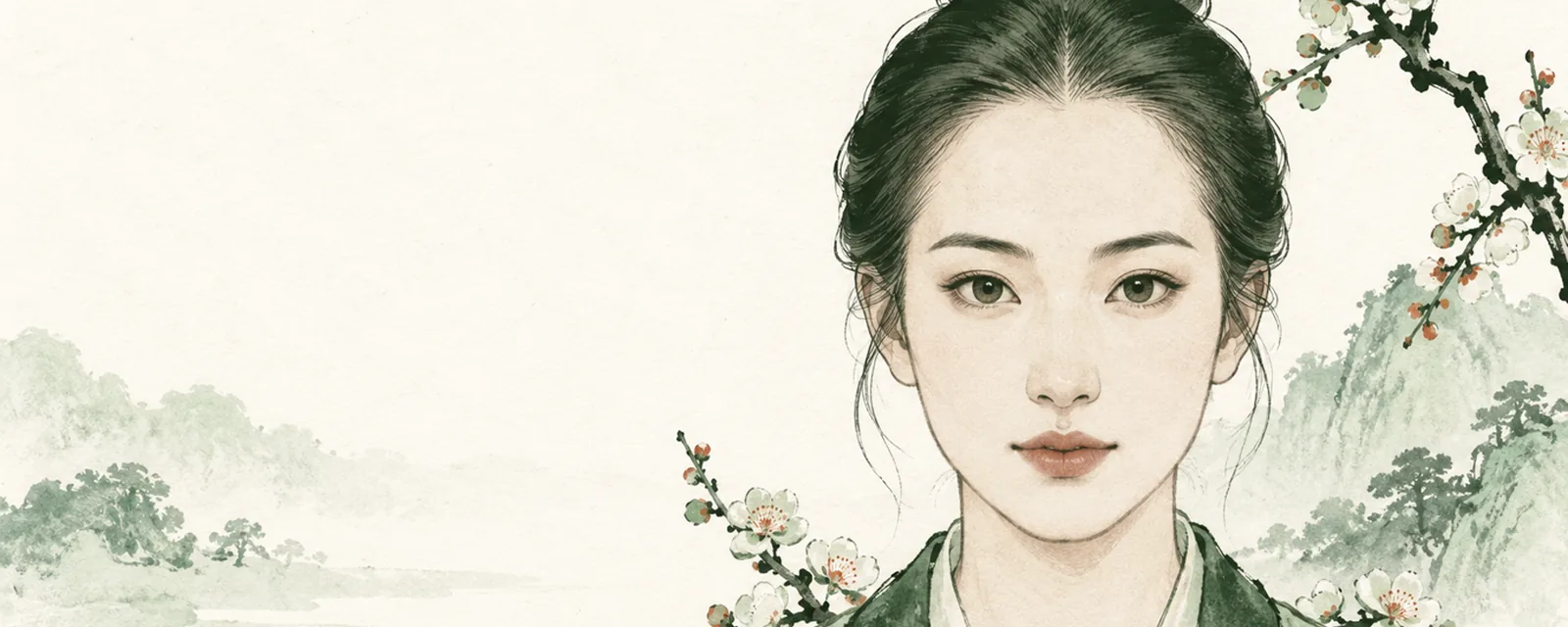
The forehead (额) in Chinese face reading: the upper section and the Career, Parents, Travel and Fortune palaces placed on it.
What the tradition looks at
- Height from brow to hairline
- Width
- Curve
The forehead, or 额 é, occupies the upper third of the face—the section known in Chinese face reading as 上停 shàng tíng, or the Heaven position. The tradition holds that this region reflects a person's early fortune, relationship with authority and elders, and capacity for planning and foresight. A well-proportioned forehead, smooth and evenly colored, was traditionally associated with favorable conditions in youth and a capacity to receive guidance and opportunity.
Within the forehead lie several important palaces: the 官禄宫 Guānlù Gōng (Career Palace) at the center, the 父母宫 Fùmǔ Gōng (Parents Palace) at the upper corners, the 迁移宫 Qiānyí Gōng (Travel Palace) at the temples, and the 福德宫 Fúdé Gōng (Fortune Palace) above the outer brows. The forehead is also counted as 南岳衡山 Nányuè Héngshān, the Southern Peak in the system of Five Peaks, and its central height is called 天庭 Tiāntíng, the Heavenly Court. These overlapping frameworks show how central the forehead is to the classical reading of the face.
01The Upper Stop in Face Reading
Chinese physiognomy divides the face vertically into three stops: upper, middle, and lower, corresponding to Heaven, Humanity, and Earth. The upper stop, 上停 shàng tíng, runs from the hairline to the eyebrows and was traditionally read as representing the years from youth to around age thirty. A broad, smooth forehead was viewed as reflecting good fortune in early life, support from parents and teachers, and intellectual clarity.
The forehead serves as the anchor of the Heaven position, and its condition was thought to influence how one navigates external structures—government, institutions, mentors. The tradition emphasized balance: too narrow and the early years might lack support; too short and the Heaven aspect was considered underdeveloped. The forehead's relationship to the middle and lower stops was understood as setting the foundation for life's trajectory.
02Classical Names, Officers, and Palaces
The forehead's central prominence, 天庭 Tiāntíng (Heavenly Court), was regarded as a seat of authority and clarity. Just below it lies the 官禄宫 Guānlù Gōng (Career Palace), also called 中正 Zhōngzhèng, which the tradition associated with official rank, public recognition, and life direction. The 父母宫 Fùmǔ Gōng (Parents Palace) occupies the left and right upper forehead, near the 日角 Rìjiǎo (Sun Angle) and 月角 Yuèjiǎo (Moon Angle), and was read as reflecting the relationship with and influence of one's parents.
At the temples, the 迁移宫 Qiānyí Gōng (Travel Palace)—sometimes called 边城 Biānchéng or 驿马 Yìmǎ—was traditionally linked to movement, relocation, and dealings far from home. Above the outer ends of the eyebrows, the 福德宫 Fúdé Gōng (Fortune Palace), near the 天仓 Tiāncāng areas, was associated with inner contentment and accumulated blessings. As 南岳衡山 Nányuè Héngshān, the forehead was considered the highest of the Five Peaks, anchoring the face's topography.
03Traditional Forehead Shapes and Types
- Square Forehead (方额 fāng é)
- A broad, squared hairline with straight edges at the temples. The tradition associated this shape with decisiveness, straightforward character, and capacity for leadership.
- Round Forehead (圆额 yuán é)
- A gently curved hairline and fullness across the upper forehead. Traditionally linked to even temperament, adaptability, and harmonious relations with elders.
- High Forehead (高额 gāo é)
- Significantly taller than average, with ample space between hairline and brows. The texts often associated height with intellectual capacity and long-range vision, though excess height could imply isolation.
- Narrow Forehead (窄额 zhǎi é)
- Limited width from temple to temple. The tradition sometimes viewed this as indicating fewer opportunities in youth or a need to rely more on oneself than on external support.
- Prominent Forehead (凸额 tū é)
- A forward projection, particularly in the upper third. Classical texts often read this as reflecting strong will and independent thought, though balance with the rest of the face was important.
- M-Shaped Hairline (美人尖 měirén jiān)
- A widow's peak forming a central dip in the hairline. The Mayi and Liuzhuang traditions mention this feature, often associating it with sensitivity and artistic inclination, though interpretations varied by text and context.
- Low Forehead (低额 dī é)
- A short vertical span, with the hairline close to the brows. Some sources linked this with pragmatic, action-oriented character, though the tradition generally favored balanced proportions.
04How the Tradition Reads the Forehead
Proportion was paramount: the forehead ideally occupied one-third of the face's height, balanced with the middle and lower stops. An overly large or small forehead was read as disrupting the harmony of Heaven, Humanity, and Earth. The skin's texture and color also mattered—the Shen Xiang Quan Bian and earlier texts praised smooth, lustrous skin as a sign of present good fortune, while blemishes, uneven tone, or furrowed lines were noted as temporary or enduring marks.
The tradition paid close attention to symmetry between left and right, especially at the Sun and Moon Angles. Fullness and even height were favored; hollows or pronounced asymmetry were sometimes read as reflecting imbalance in parental influence or early support. The forehead's relationship to its neighboring palaces—Career, Parents, Travel, Fortune—was understood as a network: a strong center (Career Palace) with weak temples (Travel Palace), for instance, suggested different patterns than the reverse.
05History and Classical Sources
Forehead reading appears in the earliest Chinese physiognomic writings. By the Song dynasty, the 麻衣相法 Máyī Xiāngfǎ, attributed to the semi-legendary Mayi Daoist, codified the three-stop system and named key positions including Tianting and the palaces. The 柳庄相法 Liǔzhuāng Xiāngfǎ, associated with the Ming-era master Yuan Gong (styled Liuzhuang) and his son Yuan Zhongche, elaborated the system of angles, peaks, and palace locations on the forehead, emphasizing symmetry and fullness.
The comprehensive 神相全编 Shén Xiàng Quán Biān, a Ming compendium traditionally linked to Chen Tuan and compiled under Yuan Zhongche's name, synthesized centuries of practice, detailing forehead shapes, the Five Peaks framework, and interpretive principles. The forehead's prominence in these texts reflects its role as the face's Heaven anchor—the point from which authority, inheritance, and early fortune were traditionally assessed.
06How ChineseFace Observes the Forehead
ChineseFace identifies visible, measurable features: the vertical height from hairline to brow, the horizontal width at the temples, the curvature or angularity of the hairline, and the relative prominence or recession of the forehead plane. The system labels the shape of the hairline (straight, rounded, M-shaped, uneven) and notes whether the forehead projects forward or recedes in profile. Symmetry between left and right sides is recorded where detectable.
The tool does not assess skin texture, fine lines, or color variations in detail, as these require close inspection and controlled lighting beyond typical photos. It maps only the structural geometry visible in a front-facing image, matching these observations to the vocabulary of traditional shapes (square, round, high, narrow, etc.). The result is a pairing of what is visible with what the classical texts associated with those shapes—a cultural reference, not a personal verdict.
07Photo Tips for Forehead Reading
- Clear the Hairline
- Pull hair back or to the side so the entire hairline and upper forehead are visible. Bangs, hats, or headbands obscure key landmarks.
- Face the Camera Directly
- A straight-on angle ensures accurate measurement of width and symmetry. Tilting the head up or down distorts the forehead's proportions.
- Even, Frontal Lighting
- Use diffuse light from in front to minimize shadows across the forehead. Side lighting can exaggerate or hide contours.
- Neutral Expression
- Relax the brow and forehead muscles. Raised eyebrows or furrowed brows alter the apparent height and create temporary lines.
- No Glasses
- Frames can cast shadows or obscure the temples and outer brow areas (Travel and Fortune Palaces).
- High Enough Resolution
- Ensure the photo is sharp and the forehead occupies enough pixels for the AI to detect hairline details and subtle curves.
08The Forehead in Relation to the Whole Face
The forehead does not stand alone; its meaning in the tradition depends on its proportion to the middle stop (brows to nose-tip) and lower stop (nose-tip to chin). An expansive forehead paired with a short lower face was read differently than one balanced across all three stops. The Career Palace at the forehead's center was understood to communicate vertically with the 印堂 Yìntáng (Seal Hall) between the brows and the nose, forming a central axis of authority and life direction.
Laterally, the temples (Travel Palace) connect the forehead to the cheekbones and ears, completing the face's outer frame. The Parents Palace links upward to the hairline and downward to the brows, bridging Heaven and the features of Humanity. In the Five Peaks system, the forehead's height and breadth were compared to the nose (Central Peak), cheekbones (Eastern and Western Peaks), and chin (Northern Peak) to assess overall balance. The tradition held that harmony among the peaks and stops revealed a life in balance; disproportion suggested areas of strength and challenge.
Related guides
Frequently asked questions
What if my hairline is receding or I'm balding?
Classical texts assumed a stable adult hairline and did not systematically address hair loss. ChineseFace maps the current visible hairline, but interpretations were written for natural, stable hairlines. Receding or absent hairlines fall outside the traditional framework.
Can forehead wrinkles be read in a photo?
Fine lines and wrinkles require close, high-resolution images and were noted in classical texts as temporary or permanent marks. ChineseFace focuses on structural shape and proportion visible in standard photos, not fine skin texture or transient lines.
Why does the tradition call the forehead the 'Heaven' position?
The three-stop system maps cosmic principles onto the face: Heaven (upper), Humanity (middle), Earth (lower). Heaven represents what is given—ancestry, early fortune, guidance from above. The forehead, at the top, was thus read as the seat of inherited potential and higher influence.