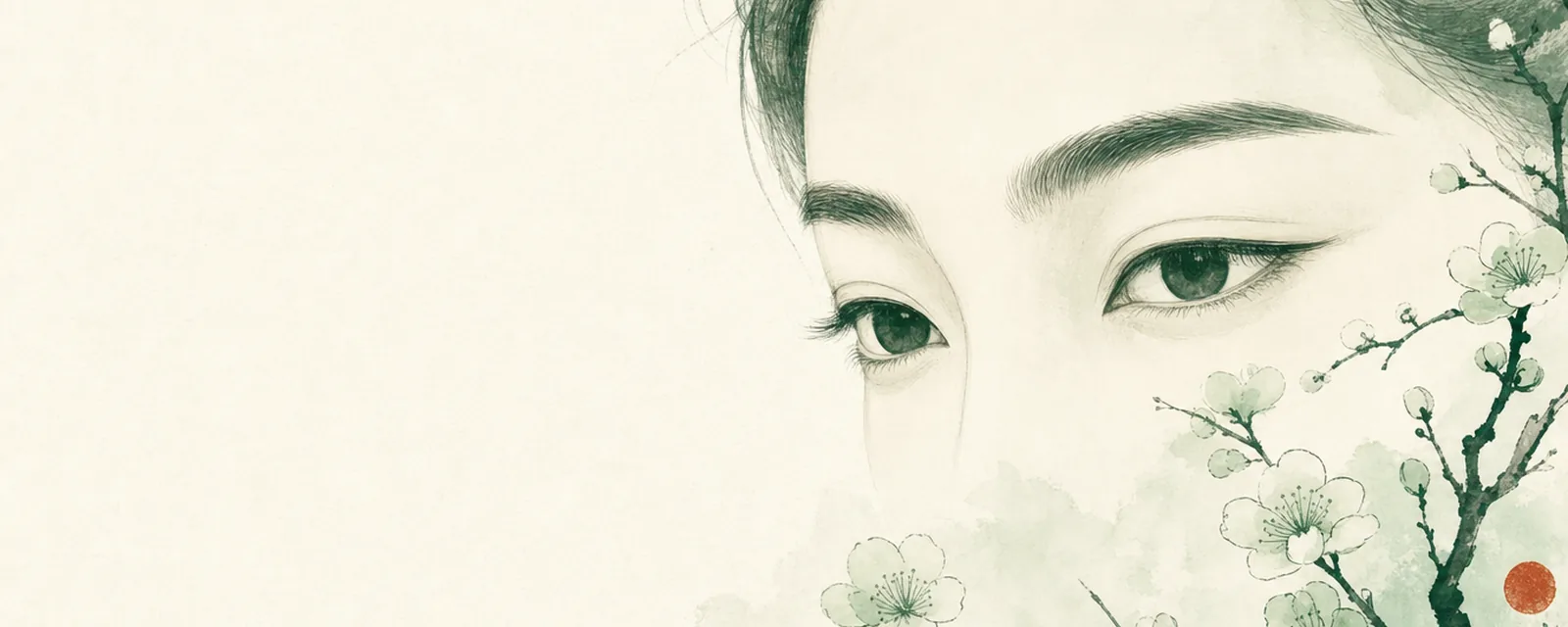
Chinese face reading
Eyes in Chinese face reading
How the Chinese face-reading tradition describes the eyes (眼), the Inspecting Officer, and the palaces around them, explained without fortune telling.
What the tradition looks at
- Eye shape
- Angle of the outer corners
- Spacing between the eyes
- The eyelid
The eyes hold a place of singular importance in Chinese face reading, regarded as the windows through which inner vitality, intelligence, and character express themselves. Known as 眼 yǎn or 目 mù in classical texts, the eyes serve as the 监察官 jiān chá guān, the Inspecting Officer among the five principal facial officers, charged with observing and judging the world. The tradition teaches that the spirit (神 shén) is most clearly visible in the eyes, and a skilled reader looks first to their clarity, focus, and balance before examining any other feature.
Beyond the eyes themselves, the surrounding regions carry distinct meanings: the eyelid area extending to the brow is the 田宅宫 tián zhái gōng or Property Palace, the area directly below the eyes is the 男女宫 nán nǚ gōng or 子女宫 zǐ nǚ gōng, the Children Palace (also called 泪堂 lèi táng, tear hall), and the outer corners are the 夫妻宫 fū qī gōng or 妻妾宫 qī qiè gōng, the Spouse Palace (奸门 jiān mén, the gate of liaison). Together, these interconnected regions form a constellation that the tradition uses to discuss family fortune, emotional life, and social relationships, always read in concert rather than isolation.
01The Eyes in Mian Xiang
In the practice of 面相 miàn xiàng, the eyes are considered the most revealing feature, the seat of 神 shén, the animating spirit or vital essence. Classical texts emphasize that all other features may be auspicious in form, yet if the eyes lack clarity or focus, the reading is incomplete. The tradition holds that the eyes reflect intelligence, integrity, and the capacity for deep feeling, and that their condition—bright or dull, steady or wandering—speaks to inner reserves of energy and purpose.
The eye region is never read in isolation. Its relationship to the eyebrows above, the cheekbones to the sides, and the nose between the eyes creates a dynamic map. The tradition teaches that balanced proportions and harmonious transitions between these areas indicate coherence in life circumstances, while marked asymmetries or harsh contrasts invite closer attention to specific palaces and their associated themes.
02Classical Names: Officers and Palaces
The eyes themselves are designated the 监察官 jiān chá guān, the Inspecting Officer, one of the five officers that include the eyebrows, nose, mouth, and ears. This title reflects the eyes' role as vigilant observers, taking in information and rendering judgment. The Inspecting Officer's clarity and steadiness were held to indicate a person's capacity for wise assessment and discernment.
The 田宅宫 tián zhái gōng, or Property Palace, occupies the eyelid and the space between brow and eye; the tradition associates this area with holdings, home, and material stability. The 男女宫 nán nǚ gōng or 子女宫 zǐ nǚ gōng, the Children Palace, lies in the 泪堂 lèi táng directly below each eye, linked in classical texts to descendants and emotional bonds. The 夫妻宫 fū qī gōng or 妻妾宫 qī qiè gōng at the outer corners, the Spouse Palace or 奸门 jiān mén, pertains to marital relationships and partnerships. Each palace has its own vocabulary of fullness, smoothness, and colour.
03Traditional Eye Shapes and Types
Classical compendia such as the 神相全编 Shen Xiang Quan Bian catalogue a rich typology of eye shapes, each with its own name and set of traditional associations. These categories describe visible contours, proportions, and the quality of the gaze, and were used as a vocabulary for describing the infinite variety of human eyes. The names often draw on animals, flowers, or celestial beings, reflecting the poetic and symbolic language of the tradition.
- Phoenix Eye (凤眼 fèng yǎn)
- An eye with a long, slightly upward-tilted outer corner and a graceful, narrow shape, often with a defined double eyelid. The tradition associated the phoenix eye with refinement, dignity, and a composed temperament.
- Dragon Eye (龙眼 lóng yǎn)
- A larger, round or slightly oval eye with a clear, bright gaze and well-defined double eyelid. Classical texts linked the dragon eye to authority, intelligence, and capacity for leadership.
- Peach-Blossom Eye (桃花眼 táo huā yǎn)
- Eyes with a soft, slightly watery appearance, often with gentle curves and a warm gaze. The tradition associated this type with charm, emotional expressiveness, and appeal to others.
- Willow-Leaf Eye (柳叶眼 liǔ yè yǎn)
- A long, narrow eye with a delicate taper at both ends, resembling the shape of a willow leaf. The willow-leaf eye was held to indicate a gentle nature and sensitivity.
- Tiger Eye (虎眼 hǔ yǎn)
- A round, prominent eye with a fierce or penetrating quality, often with visible white around the iris. The tradition linked this type to courage, decisiveness, and a strong will.
- Crane Eye (鹤眼 hè yǎn)
- Eyes with a clear, focused gaze and a slightly elongated shape, often set high on the face. Classical sources associated the crane eye with longevity, clarity of thought, and a tranquil disposition.
- Drunken Eye (醉眼 zuì yǎn)
- Eyes that appear slightly heavy-lidded or sleepy, with a relaxed, half-closed appearance. This type was described in texts as indicating a laid-back or indulgent temperament.
- Triangular Eye (三角眼 sān jiǎo yǎn)
- Eyes with a pronounced downward slope at the outer corner, creating a triangular impression. The tradition noted this shape as suggesting wariness or a calculating nature.
04How the Tradition Reads the Eyes
Classical face-reading texts emphasize the importance of 神 shén, the spirit visible in the eyes, above any particular shape. A clear, steady gaze with brightness in the iris was held to be the most auspicious sign, indicating vitality, focus, and integrity. Conversely, dull, evasive, or clouded eyes were read as indicating depletion, distraction, or inner turmoil. The whites of the eyes also received attention: excessive white visible above or below the iris (三白眼 sān bái yǎn, three-whites eye, or 四白眼 sì bái yǎn, four-whites eye) was traditionally noted.
Proportion and symmetry matter greatly. Eyes that are balanced in size, evenly set, and harmonious with the nose and brows were considered ideal. The surrounding palaces—fullness in the Property Palace eyelid area, smoothness and colour in the Children Palace below, and unblemished outer corners in the Spouse Palace—were all part of the assessment. Texture, colour, and the presence of fine lines were observed as indicators of vitality and the passage of time. The tradition teaches that all these factors are read together, never in isolation.
05History and Classical Sources
References to the eyes as central to physiognomic assessment appear in early Chinese thought; even Xunzi's essay 非相 fēi xiàng, which argued against physiognomy, acknowledged the popular focus on the eyes as windows to character. By the Song dynasty, texts such as the 麻衣相法 Mayi Xiangfa, attributed to the semi-legendary Mayi Daoist, had systematized eye types and their associations. The tradition flourished in the Ming period with the work of Yuan Gong 袁珙 (styled Liuzhuang), a physiognomist whose readings were recorded and later compiled in the 柳庄相法 Liuzhuang Xiangfa and the 神相全编 Shen Xiang Quan Bian, a comprehensive compendium traditionally connected to Chen Tuan and compiled under Yuan Zhongche's name. These texts describe dozens of eye types and their nuances, emphasizing the primacy of spirit and clarity over shape alone.
06How ChineseFace Observes the Eyes
When you upload a photo to ChineseFace, the system examines visible geometric features of the eye region: the shape and contour of the eye opening, the presence or absence of a visible eyelid crease, the position and angle of the outer corners, and the relative size and spacing of the eyes. It notes the proportions of the surrounding palaces—the eyelid area above, the infraorbital area below, and the temple region at the outer corners. All observations are expressed using a fixed vocabulary of shape and proportion terms, never free interpretation.
What cannot be observed in a still photograph includes the quality of the gaze, the brightness or clarity of the iris and whites, the movement or focus of the eyes, and subtle colour variations in the surrounding skin. The 神 shén, the animating spirit so central to classical readings, is not visible in a static image. ChineseFace pairs observable shape features with what the tradition has said about those shapes, clearly framed as cultural heritage rather than personal analysis. The photo is processed only for feature mapping and then deleted.
07Photo Tips for the Eye Region
- Face the camera directly
- A straight-on view with the face level ensures that eye shape, symmetry, and spacing are captured accurately without distortion from angle or tilt.
- Use even, diffuse lighting
- Soft, front-facing light without harsh shadows allows the contours of the eyelids, the corners, and the surrounding areas to be clearly visible.
- Keep a neutral expression
- A relaxed, neutral face with eyes open naturally reveals the true shape of the eye opening and the position of the eyelid; squinting or wide eyes can alter appearance.
- Remove glasses and clear hair from the face
- Glasses obscure the eye region entirely, and hair covering the brows, temples, or cheeks hides the relationship between the eyes and neighbouring features.
- Ensure the image is sharp and well-focused
- A clear photo allows the system to detect fine contours, the eyelid crease, and the precise angles of the eye corners, improving the accuracy of the shape vocabulary applied.
- Avoid heavy makeup or filters
- Heavy eyeliner, false lashes, or digital filters can alter the apparent shape, size, and proportion of the eyes, leading to less accurate feature mapping.
08Relationship to Neighbouring Regions
The eyes exist in constant dialogue with surrounding features. The eyebrows above frame and protect the eyes; classical texts teach that well-formed brows and clear eyes together indicate both intellect and integrity. The nose between the eyes serves as an anchor; the distance from the root of the nose (山根 shān gēn) to each inner corner affects the sense of balance and openness. The cheekbones to the sides provide structural support; their height and prominence influence how the eye area is perceived and how the palaces below the eyes (Children Palace) appear.
The full face map is a web of relationships. A feature read in isolation loses context; the tradition insists on observing the whole. Eyes that are beautifully shaped yet poorly balanced with the nose and brows, or surrounded by hollow or discoloured areas in the adjacent palaces, present a different picture than the same eyes in a harmonious setting. ChineseFace's feature map reflects this interconnection, showing how each region contributes to the traditional reading of the face as a unified landscape.
Related guides
Frequently asked questions
Why does the tradition emphasize 神 shén, the spirit in the eyes?
Classical texts teach that spirit—brightness, focus, and vitality—is the essence of a meaningful reading, more important than shape alone. A still photo cannot capture this quality, which is why ChineseFace focuses on observable geometry and clearly states the limits of static images.
What are the three-whites and four-whites eyes mentioned in texts?
三白眼 sān bái yǎn (three-whites) refers to visible white on three sides of the iris—typically below and on both sides—while 四白眼 sì bái yǎn (four-whites) shows white on all four sides. Classical sources noted these as distinctive features; the tradition associated them with particular character themes, though interpretations vary between texts.
How do I know which classical eye type I have?
Eye types in the tradition are descriptive categories, not rigid classifications; many eyes blend features of multiple types. ChineseFace identifies visible shape and proportion using a fixed vocabulary, then shows what the tradition has said about those shapes. The classical names are poetic and fluid, not diagnostic labels.