Chinese face reading
The chin in Chinese face reading
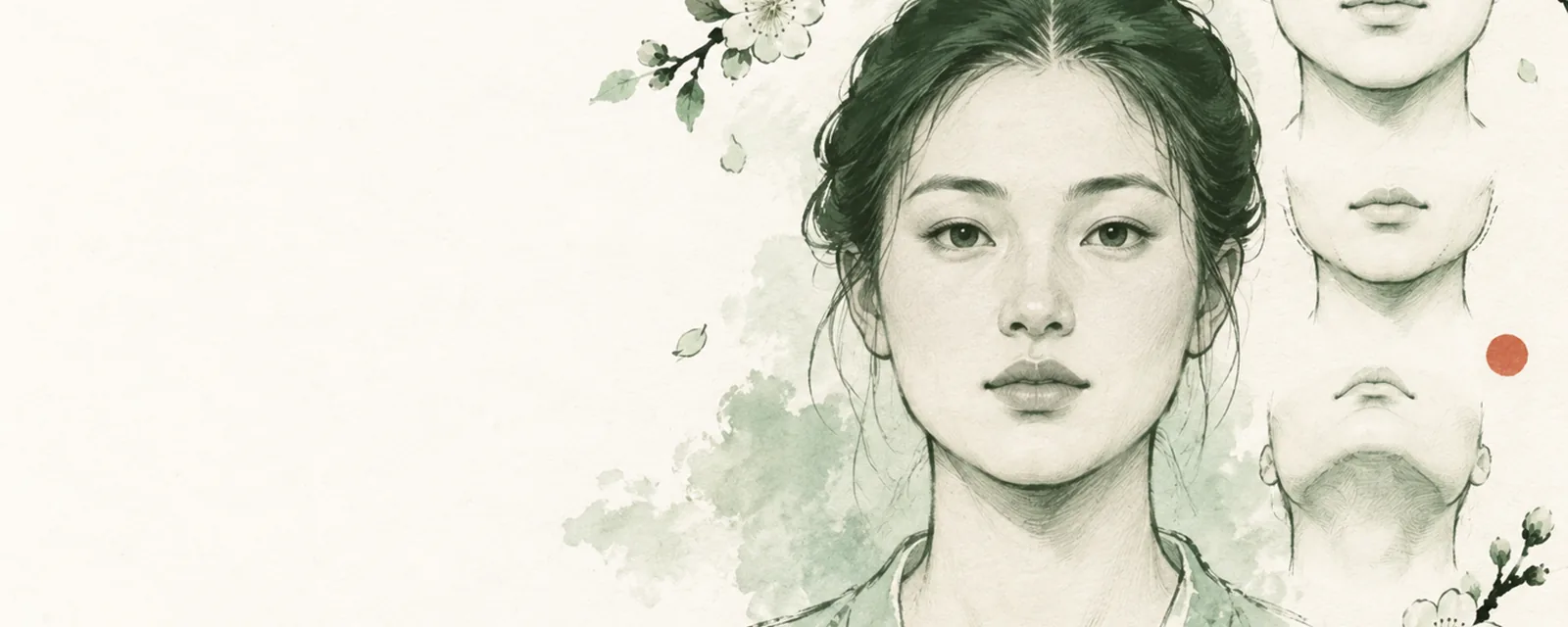
The chin and jaw (颏) in Chinese face reading: the lower section and the Friends Palace, with the shapes the tradition describes.
What the tradition looks at
- Rounded, squared or pointed shape
- How far the chin projects
- How the jawline meets it
The chin and jaw—颏 (kē) and jawbone 腮骨 (sāi gǔ)—form the lowest section of the face in the three-division model, known as the Lower Stop 下停 (xià tíng). This region represents the Earth position 地 (dì) and is associated in the tradition with the later years of life, roughly from the fifties onward, as well as with stability, support from others, and one's foundation in the world. A well-formed chin and jaw were seen as signs of endurance and capacity to sustain effort over time.
Within the palace system, the sides of the lower jaw and chin encompass the Friends and Servants Palace 奴仆宫 (nú pú gōng), reflecting the traditional view of one's relationships with subordinates, employees, and support networks. The central chin itself is called 地阁 (dì gé), the Earth Pavilion, and is also identified as the Northern Peak 北岳恒山 (běi yuè héng shān) in the Five Peaks 五岳 (wǔ yuè) mapping of the face. Together, these features close the facial structure and provide the foundation for the entire countenance.
01The Chin and Jaw in Face Reading
The chin and jaw anchor the face in mian xiang 面相, representing the final stage of the vertical journey from forehead to chin. As the Earth element in the tripartite division, this region was traditionally associated with material security, perseverance, and the capacity to see endeavors through to completion. The tradition held that a solid, well-proportioned lower face suggested resilience and the ability to weather challenges in later life.
The jawbone and chin contour also frame the lower third of the face, providing structural balance to the cheeks and mouth above. Classical texts emphasized that the chin should harmonize with the forehead and mid-face: an imbalanced or weak lower section was thought to indicate a lack of grounding, while excessive width or prominence might signal other qualities. The chin's shape, width, and projection were all carefully considered.
02Classical Names, Officers, and Palaces
The central chin is known as 地阁 (dì gé), the Earth Pavilion, reflecting its role as the lowest and most grounded part of the face. It is also designated as 北岳恒山 (běi yuè héng shān), the Northern Peak, one of the Five Peaks that map the face as a sacred landscape. The jawbone on either side is called 腮骨 (sāi gǔ), and the lower lateral regions of the jaw and chin together form the Friends and Servants Palace 奴仆宫 (nú pú gōng), which the tradition associated with one's relationships to helpers, staff, and those who provide support.
Some texts also refer to the chin area as part of the 十二宫 (shí èr gōng), the Twelve Palaces, and note age positions in the seventies and beyond marked along the chin and jaw edge. The chin's correspondence to the Earth element and to late-life years gave it symbolic weight as the final anchor of fortune and vitality in the traditional reading sequence.
03Traditional Chin and Jaw Shapes
Classical texts describe a variety of chin and jaw forms, each associated with different qualities. The following types appear frequently in traditional sources, though names and exact classifications vary between the Mayi, Liuzhuang, and Shen Xiang Quan Bian lineages.
- Round Chin (圆颏 yuán kē)
- A smoothly rounded chin with gentle curves and no sharp angles. The tradition associated this shape with amiability, adaptability, and harmonious relations in later years.
- Square Chin (方颏 fāng kē)
- A broad, angular chin with a flat or slightly horizontal lower edge. This form was linked to determination, practicality, and a strong sense of responsibility.
- Pointed Chin (尖颏 jiān kē)
- A chin that tapers to a narrow, pointed tip, often forming a V-shape with the jawline. Traditionally seen as indicating quickness of thought and sensitivity, though sometimes interpreted as less robust in endurance.
- Protruding Chin (突颏 tū kē)
- A chin that juts forward prominently relative to the mouth and mid-face. The tradition sometimes associated pronounced projection with tenacity and forcefulness of character.
- Receding Chin (缩颏 suō kē)
- A chin that sits back or slopes away from the lower lip, creating a less pronounced profile. Classical texts varied in their readings, often noting a lack of assertiveness or reserve.
- Double Chin (重颏 chóng kē)
- A chin with an additional fold or layer of flesh beneath it, creating a doubled appearance. Some sources associated this with abundance and comfort, while others noted concerns about excess or indulgence.
- Wide Jaw (阔腮 kuò sāi)
- A jawbone that flares outward, creating a broad lower face. Traditionally linked to strength, authority, and the capacity to command or manage others.
- Narrow Jaw (窄腮 zhǎi sāi)
- A jawline that is slender and tapers sharply from cheek to chin. Classical readings often interpreted this as indicating refinement or a more delicate constitution in later life.
04How the Tradition Interprets the Chin and Jaw
Traditional face reading emphasized proportion and balance: the chin should be neither too large nor too small relative to the forehead and mid-face, and the jawline should frame the face symmetrically. A well-formed 地阁 (dì gé) with fullness and smooth contours was thought to indicate stability and support in the later years, while asymmetry, hollowness, or excessive sharpness might suggest challenges. The texture and color of the skin over the chin were also noted—smoothness and healthy tone were preferred, and unusual marks or discoloration drew attention.
The relationship between the chin and the mouth, cheeks, and nose mattered greatly. A chin that receded too far might be seen as lacking support for the features above, while an overly prominent jaw could be read as dominating the face's harmony. The tradition also considered the angle of the jaw and the visibility of the jawbone from the front, with a balanced, gently defined structure favored over extremes of angularity or softness.
05Classical Sources and History
The Mayi Xiangfa 麻衣相法, a text attributed to the Song-era Mayi Daoist tradition, discusses the chin as part of the three divisions and emphasizes its connection to late-life fortune and the Earth element. The Liuzhuang Xiangfa 柳庄相法, associated with the Ming physiognomist Yuan Gong 袁珙 (styled Liuzhuang), provides detailed descriptions of jaw and chin shapes and their traditional meanings, often emphasizing structural solidity. The Shen Xiang Quan Bian 神相全编, a comprehensive Ming compendium, synthesizes earlier material and includes the chin and jaw prominently in its palace and age-position maps, noting the Northern Peak and the Friends Palace. All these texts build on older currents of thought, though precise chin typologies and interpretations vary.
06What ChineseFace Observes in Your Photo
ChineseFace uses computer vision to identify the visible contours and proportions of the chin and jawline in your uploaded image. The system maps the lower edge of your face, noting the shape of the chin (rounded, square, pointed, and so on) and the angle and prominence of the jawbone. It measures the width of the jaw relative to the mid-face and the projection of the chin relative to the mouth and nose. The analysis is purely geometric, based on what is visible in the photo.
The AI cannot assess skin texture, subtle color variations, or the feel of bone structure beneath the skin—only the outline and major contours visible in a well-lit, front-facing image. Features like a double chin or the exact angularity of the jaw depend on clear visibility; shadows, tilted angles, or facial hair can obscure these details. The result is a fixed-vocabulary label describing the observed shape, which is then paired with what the tradition has historically said about that form.
07Photo Tips for Accurate Chin and Jaw Observation
To help ChineseFace observe your chin and jaw clearly, follow these guidelines when uploading your photo.
- Face the camera directly
- A straight-on view ensures the chin and jawline are symmetrical and fully visible. Tilting your head up or down can distort the apparent shape and projection of the chin.
- Use even, frontal lighting
- Soft light from the front illuminates the chin and jaw without heavy shadows under the jaw or along the sides. Overhead or side lighting can obscure contours and create misleading shadows.
- Keep the lower face clear
- Avoid scarves, high collars, or hands near your chin. Facial hair should be neatly groomed if possible, so the actual jawline and chin edge are distinguishable.
- Relax your jaw and face
- A neutral, natural expression allows the chin to sit in its normal position. Clenching your jaw or jutting your chin forward will alter the observed shape and projection.
- Frame the entire lower face
- Ensure your chin and the full curve of your jawline from ear to ear are within the image. Cropping too tightly at the bottom cuts off the 地阁 and prevents accurate shape detection.
- Choose a plain background
- A simple backdrop behind you helps the AI distinguish your chin and jaw edges clearly, avoiding confusion with patterned or cluttered surroundings.
08The Chin and Jaw in the Whole-Face Context
The chin and jaw complete the vertical structure of the face and must harmonize with the forehead (Upper Stop) and the mid-face (Middle Stop) for a balanced reading. A strong chin with a weak or narrow forehead, or vice versa, creates an imbalance that traditional readers noted carefully. The chin also relates closely to the mouth above it: the 地阁 (dì gé) provides the foundation for the lips and mouth palaces, and a receding or overly prominent chin affects the proportional harmony of that region.
Laterally, the jawbone connects to the cheeks 颧骨 (quán gǔ) and the sides of the face, influencing the overall width and frame. The Friends and Servants Palace 奴仆宫 along the lower jaw sits beside the Law Lines 法令纹 (fǎ lìng wén) and the lower cheek, linking the chin's stability to the support and relationships represented by those features. The tradition viewed the face as an interconnected map: the chin's form and balance ripple outward, contributing to the holistic reading of character, fortune, and life's arc.
Related guides
Frequently asked questions
Why does the tradition call the chin the Northern Peak?
Classical face reading mapped the face as a landscape of five sacred peaks, the 五岳 (wǔ yuè). The chin, as 北岳恒山 (běi yuè héng shān), represented the northern mountain, symbolizing stability and the grounding of the Earth element. This poetic geography reflected the cosmological thinking of the time.
Can ChineseFace detect a double chin or jawbone structure?
ChineseFace observes visible contours in your photo—a clear double chin or pronounced jawline can be mapped if the image is well-lit and front-facing. However, it cannot assess bone structure beneath the skin or subtle variations obscured by shadows, angles, or facial hair.
What if my chin looks different from different angles?
Everyone's chin and jaw change appearance with head tilt, lighting, and camera distance. ChineseFace analyzes the front-facing view you upload, which is the standard perspective in traditional mian xiang. For consistency, use a straight-on photo with neutral expression and even light.
Which classical text is most detailed about chin shapes?
The Shen Xiang Quan Bian 神相全编 provides extensive typologies and incorporates material from earlier sources like the Mayi and Liuzhuang traditions. However, classifications and names for chin shapes vary across texts, so no single source is exhaustive or universally authoritative.